

The Congress on Thursday unveiled its list of candidates for the March 16 Rajya Sabha elections, blending experience with surprise selections that have already sparked conversations within party circles. Senior leader and prominent spokesperson Abhishek Singhvi is set to return to the Upper House from Telangana, while Kangra district Congress chief Anurag Sharma and Haryana leader Karamvir Baudh have emerged as unexpected nominees.
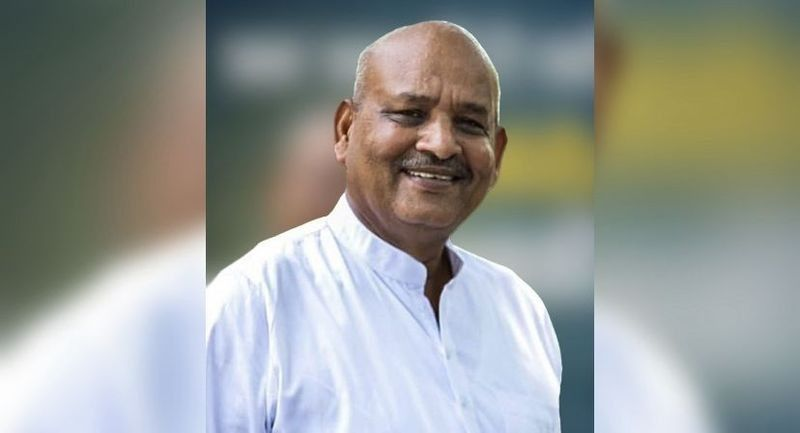
Singhvi’s renomination from Telangana signals continuity and stability. A seasoned parliamentarian known for his sharp legal arguments and articulate presence in debates, Singhvi has long been one of the Congress’s most recognisable national faces. With the party in power in Telangana under Chief Minister Revanth Reddy, the numbers appear favourable for his smooth return to the Rajya Sabha. His presence in the Upper House is likely to strengthen the party’s legal and parliamentary strategy at a time when legislative confrontations are expected to intensify.
In Himachal Pradesh, the choice of Anurag Sharma has raised eyebrows. Sharma, who heads the Congress in Kangra district and is considered close to Chief Minister Sukhvinder Singh Sukhu, has been elevated at a politically sensitive moment. Former state Congress chief Pratibha Singh was reportedly expecting a nomination for herself or her son, Vikramaditya Singh. Instead, the party leadership opted for Sharma, a move that insiders describe as a reward for organisational loyalty and grassroots engagement. The decision underlines the high command’s preference for balancing internal equations while promoting leaders seen as aligned with the current state leadership.
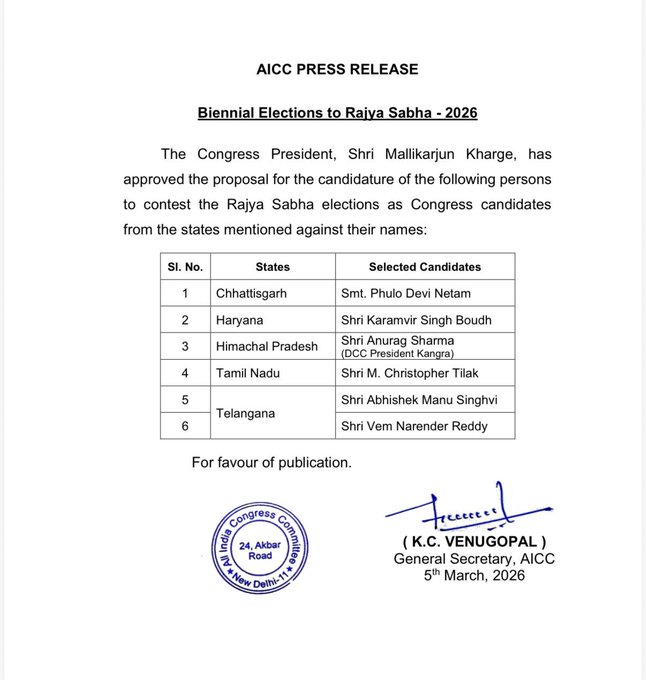
Perhaps the most intriguing nomination comes from Haryana, where Karamvir Baudh has been fielded despite not belonging to any dominant faction within the state Congress. A former secretary of the Scheduled Caste cell at the All India Congress Committee, Baudh is widely regarded as a high command-backed candidate. His elevation reflects the party’s emphasis on social representation and outreach to Scheduled Caste communities. By choosing a leader without strong factional baggage, the Congress appears to be signalling neutrality and inclusiveness in a state often marked by internal rivalries.
The party has also renominated tribal leader Phulo Devi Netam from Chhattisgarh, reinforcing its commitment to tribal representation. In Telangana, Vem Narender Reddy, an adviser to Chief Minister Revanth Reddy, has also secured a nomination, further strengthening the state unit’s influence in the Upper House.

Taken together, the candidate list reflects a calculated mix of experience and experimentation. While Singhvi’s return ensures a seasoned voice in Parliament, the selection of Sharma and Baudh points to a broader political strategy—rewarding organisational leaders, balancing caste and regional equations, and consolidating internal alignments ahead of future electoral battles.
The Rajya Sabha elections may not capture the public imagination in the same way as general elections, but within party corridors, they often signal deeper shifts in strategy and power structures. With these nominations, the Congress has made it clear that it is willing to take measured risks while preserving its core parliamentary strength.
Also Read
 Jay Pawar Shares Video Allegedly Showing VSR Ventures Owner Rohit Singh Sleeping in Cockpit
As March 16 approaches, the focus will remain not just on the electoral arithmetic, but on how these choices reshape internal dynamics and influence the party’s voice in the Upper House.