
Kiranjeet Kaur
Advocate
Phone No.: 7009197871
Water is the foundation of life on Earth. From ancient civilisations to modern cities, human survival and progress have always depended upon the availability of water. Rivers, lakes, and underground aquifers have shaped settlement patterns, agriculture, and economies across the world. Despite the fact that nearly three-fourths of the Earth’s surface is covered with water, only a very small fraction of it is fresh and accessible for human use. Today, water scarcity has emerged as one of the most pressing global challenges, threatening not only environmental balance but also social stability, economic growth, and human dignity.
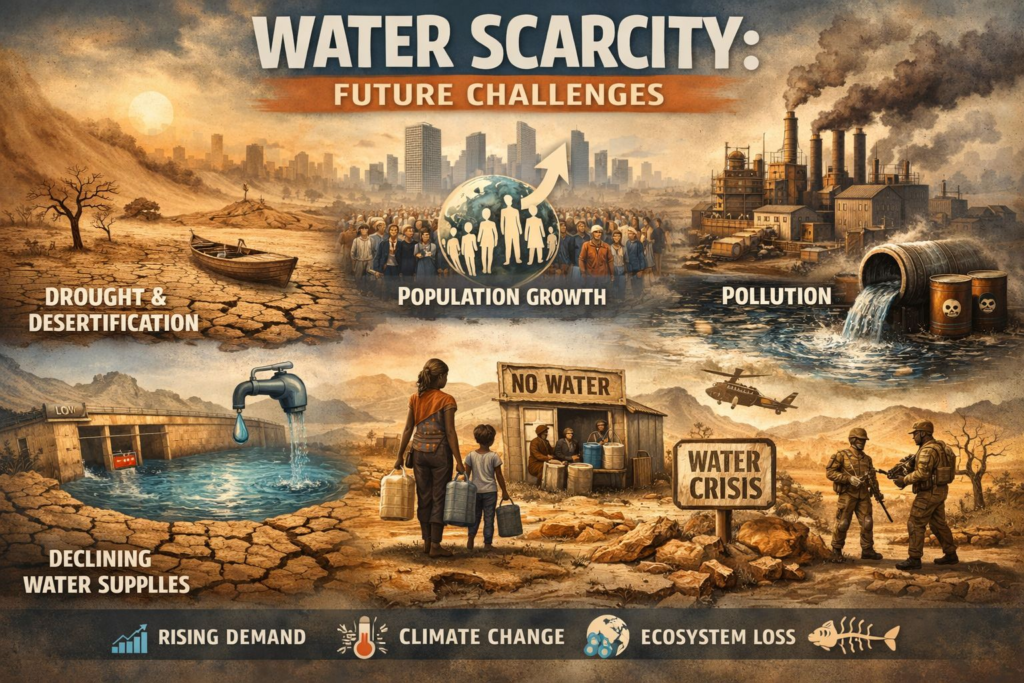
Water scarcity refers to a situation where the available water resources are insufficient to meet the needs of a population. This condition is no longer limited to drought-prone or arid regions. It has become a widespread phenomenon affecting urban and rural areas alike. Millions of people across the world already face daily struggles to access safe drinking water, and the situation is expected to worsen if current patterns of consumption and mismanagement continue. The problem is complex and multidimensional, rooted in population growth, climate change, pollution, urbanisation, and ineffective governance.
Rapid population growth is one of the major drivers of water scarcity. As the population increases, the demand for water for drinking, sanitation, agriculture, and industry rises sharply. Expanding cities consume enormous quantities of water, often diverting it from rural and agricultural regions. The imbalance between demand and supply continues to widen, placing immense pressure on rivers, reservoirs, and groundwater sources. At the same time, changes in lifestyle and consumption patterns have significantly increased per-capita water use, further intensifying the crisis.
Climate change has added a new layer of uncertainty to water availability. Changing weather patterns have disrupted traditional rainfall cycles, leading to frequent droughts in some regions and devastating floods in others. The unpredictability of monsoons has made water planning increasingly difficult, particularly in countries heavily dependent on seasonal rainfall. Rising global temperatures have increased evaporation rates, reducing surface water and soil moisture essential for agriculture. The rapid melting of glaciers, which act as natural freshwater reservoirs, poses a serious long-term threat to water security once these ice reserves are exhausted.
Groundwater depletion has become a silent but severe crisis. In many parts of the world, groundwater serves as the primary source of water for domestic use and agriculture. Excessive and unregulated extraction has caused water tables to fall at alarming rates. Wells and borewells are being drilled deeper each year, making access to water increasingly expensive and unsustainable. Once depleted, groundwater reserves take decades or even centuries to recharge, turning temporary shortages into permanent scarcity.
Agriculture remains the largest consumer of freshwater resources. Traditional irrigation practices, particularly flood irrigation, result in massive wastage of water. The cultivation of water-intensive crops in regions with limited water availability has further strained resources. Inadequate awareness, lack of technological adoption, and absence of policy incentives for sustainable farming have prevented meaningful reform in agricultural water use. As water scarcity intensifies, food security is likely to face serious challenges, affecting both farmers and consumers.
Urbanisation has placed additional stress on already fragile water systems. Unplanned urban expansion has led to the overextraction of water from nearby and distant sources, often at the cost of surrounding ecosystems. Ageing infrastructure, leaking pipelines, illegal connections, and poor maintenance contribute to significant water loss before it even reaches consumers. Marginalised communities and urban slums frequently suffer from irregular supply and poor water quality, highlighting deep inequalities in access to this essential resource.
Water pollution has further reduced the availability of usable water. Industrial effluents, untreated sewage, agricultural chemicals, and plastic waste contaminate rivers, lakes, and groundwater. Polluted water not only becomes unfit for consumption but also poses serious health risks, leading to the spread of waterborne diseases. Treating contaminated water requires significant financial and technological investment, placing additional burden on public resources. In many cases, pollution has permanently damaged water bodies, effectively converting potential resources into unusable ones.
The social and economic consequences of water scarcity are profound. Scarcity directly affects public health, nutrition, and sanitation. Declining agricultural output due to water shortages leads to food insecurity and rising prices. In rural areas, women and children often bear the burden of fetching water from distant sources, limiting opportunities for education and employment. Industrial sectors dependent on water face operational disruptions, resulting in economic losses and unemployment. Disputes over water sharing between states, regions, and communities are becoming increasingly frequent, raising concerns about future conflicts.
Water governance remains one of the weakest links in addressing this crisis. Fragmented laws, overlapping authorities, and weak enforcement mechanisms allow overexploitation and pollution to continue unchecked. Water is often treated as an unlimited and free resource rather than a finite and shared responsibility. The absence of long-term planning and community participation has undermined efforts to achieve sustainable water management.
If current trends continue, the future presents serious challenges. Climate-induced migration, intensifying water conflicts, declining agricultural productivity, and recurring public health emergencies may become common realities. Urban centres could face severe rationing, while rural livelihoods may collapse under prolonged water stress. Water scarcity has the potential to destabilise societies and economies if left unaddressed.
Addressing water scarcity requires urgent and coordinated action. Sustainable water management practices such as rainwater harvesting, wastewater recycling, protection of wetlands, and adoption of efficient irrigation methods can significantly reduce pressure on water resources. Technological innovation must be supported by strong legal frameworks and effective policy implementation. Equally important is public awareness and community involvement, as conservation efforts cannot succeed without collective participation.
Every individual has a role to play in preserving water for future generations. Responsible usage, reduction of wastage, and respect for water as a shared resource are essential steps toward sustainability. Water conservation is not merely a governmental obligation; it is a moral and social responsibility.
Water scarcity stands as one of the greatest challenges of our time. It threatens survival, stability, and sustainable development. The decisions taken today will determine whether future generations inherit a world of water security or one defined by crisis and conflict. Protecting water resources is not an option but an urgent necessity for the survival of humanity.