

Veteran British journalist and former BBC India correspondent Sir William Mark Tully passed away on Saturday afternoon in New Delhi. He was 90. Family sources confirmed that Tully suffered a stroke late Friday night and was admitted to a private hospital, where he died earlier today. His death brings to a close a remarkable chapter in international journalism, particularly in India, where his voice became synonymous with credibility and calm reporting for decades.
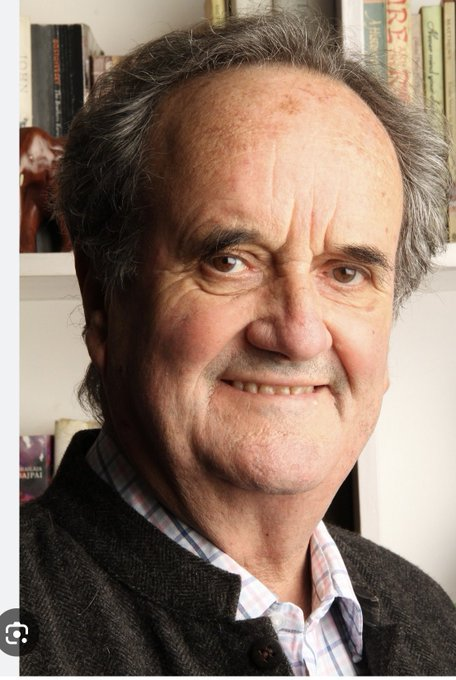
William Mark Tully was one of the most recognisable foreign journalists in the Indian subcontinent. For over 20 years, he served as the Bureau Chief of the British Broadcasting Corporation (BBC) in New Delhi, reporting on some of the most defining political and social moments in India’s modern history. At a time when radio was the primary source of news and reporting required patience, precision, and deep fieldwork, Tully earned the trust of millions of listeners across the country.
Born on October 24, 1935, in Tollygunge, then part of undivided 24 Parganas, Tully arrived in New Delhi in December 1965. One of his earliest major assignments was covering the funeral of Prime Minister Lal Bahadur Shastri in January 1966. That report marked the beginning of a long association with India that would last a lifetime, both professionally and personally.
During his career, Tully covered a wide range of historic events, including the Emergency period, the turbulent years of Indira Gandhi’s leadership, Operation Blue Star, the assassination of Rajiv Gandhi, the Babri Masjid demolition, and the political and economic transition under Prime Minister P.V. Narasimha Rao. His reporting stood out for its balance, context, and deep understanding of India’s complexities rather than sensationalism.
Relations between the BBC and the Indian government became strained in the early 1970s after the broadcaster aired documentaries such as Calcutta and Phantom India, which were perceived as portraying India negatively. As a result, the BBC’s offices in India were shut between 1970 and 1972. In 1975, amid heightened tensions, Mark Tully was forced to withdraw from India and was sent to East Pakistan, where he became one of the few journalists to gain early access to the region. During this period, he also became one of the first foreign reporters to interview Sheikh Mujibur Rahman.
Tully returned to India in 1977 following the end of the Emergency and went on to interview Indira Gandhi on multiple occasions. His coverage of Operation Blue Star remains one of the most closely followed journalistic accounts of the period. It is well documented that he spoke with Jarnail Singh Bhindranwale just days before the Indian Army’s operation at the Golden Temple, offering rare insights into a highly sensitive chapter of Indian history.
Beyond broadcasting, Mark Tully was also a prolific author. He wrote several influential books that examined India’s political, cultural, and social evolution with honesty and empathy. His notable works include No Full Stops in India, Amritsar: Mrs Gandhi’s Last Battle, The Heart of India, India in Slow Motion (co-authored), and India: The Road Ahead. His writing reflected a deep curiosity about the country and a willingness to engage with its contradictions.
In his later years, Tully divided his time between New Delhi and McLeodGanj. He often described himself, with characteristic humour, as “the last relic of the Raj.” A devout Anglican, he frequently spoke about the spiritual connections he felt between his Christian faith and India’s pluralistic traditions. UNESCO once described him as a “living witness” to the era when radio journalism played a central role in shaping public opinion.
Mark Tully’s legacy is defined by integrity, restraint, and an unwavering commitment to factual storytelling. He did not merely report on India from a distance; he lived in the country, understood its people, and conveyed their stories to the world with respect and depth. As tributes pour in from journalists, political leaders, and listeners across generations, his passing is being mourned as the loss of one of the most trusted and influential voices in global journalism.