

US President Donald Trump on Thursday unveiled his long-anticipated Gaza “Board of Peace” during the World Economic Forum in Davos, introducing a new international mechanism aimed at managing Gaza’s post-war transition. The initiative, announced alongside senior members of the US administration, has already secured participation from 35 countries, including Pakistan and the United Arab Emirates, according to officials familiar with the plan.
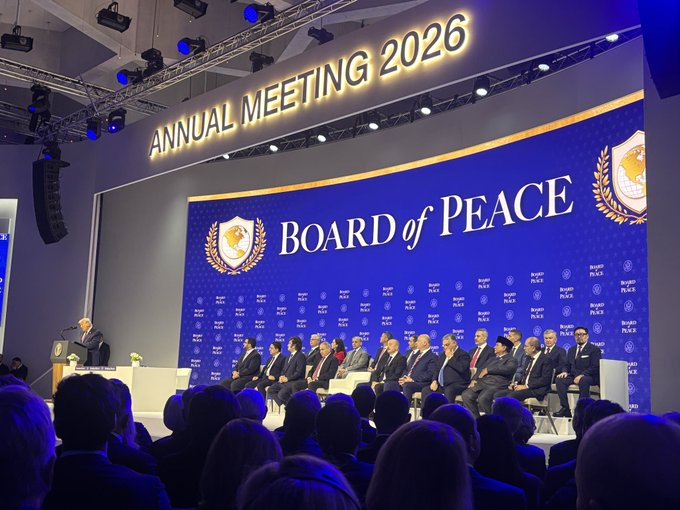
Holding a signed charter of the newly formed body, Trump said the board would ensure Gaza is fully demilitarised and rebuilt under international supervision. He described the initiative as a decisive step toward long-term stability in the region, moving beyond temporary ceasefires and emergency diplomacy.
The Board of Peace is expected to oversee Gaza’s transition following the ceasefire that took effect on October 10, 2025, which is now progressing into its second phase. Senior US officials said the board’s mandate includes forming a new Palestinian administrative committee in Gaza, deploying an international security force, disarming Hamas, and supervising the reconstruction of the war-ravaged territory.
Addressing global leaders and delegates in Davos, Trump claimed the initiative had drawn widespread interest. He said many nations were eager to participate and added that the United States would continue working with international institutions, including the United Nations, as the plan moves forward.
Countries That Have Joined the Board of Peace
According to reports by the Associated Press, the following countries have formally agreed to join the Board of Peace:
Confirmed Participants
- Argentina
- Armenia
- Azerbaijan
- Bahrain
- Belarus
- Egypt
- Hungary
- Indonesia
- Jordan
- Kazakhstan
- Kosovo
- Morocco
- Pakistan
- Qatar
- Saudi Arabia
- Turkey
- United Arab Emirates
- Uzbekistan
- Vietnam
The presence of several Middle Eastern and Muslim-majority nations is being seen as crucial for the board’s regional credibility.
Countries That Have Declined or Remain Undecided
Countries Not Joining (For Now)
However, a number of influential countries have chosen not to join at this stage. France, Norway, Slovenia, Sweden, and the United Kingdom have declined participation for now, while others remain undecided. Countries that have been invited but have yet to make a commitment include India, China, Germany, Italy, Russia, Singapore, Thailand, Cambodia, Croatia, Paraguay, Ukraine, and the European Union’s executive arm.
- France
- Norway
- Slovenia
- Sweden
- United Kingdom
Invited but Noncommittal
- Cambodia
- China
- Croatia
- Germany
- India
- Italy
- European Union (Executive Arm)
- Paraguay
- Russia
- Singapore
- Thailand
- Ukraine
Diplomatic sources say many countries are weighing concerns over sovereignty, mandate clarity, and long-term enforcement mechanisms before committing.
The launch event at Davos was attended by US Secretary of State Marco Rubio, US special envoy Steve Witkoff, and Jared Kushner, the president’s son-in-law and a key overseas negotiator for the administration. According to reports, senior leaders and diplomats from several countries were also expected to be present, including Saudi Arabia’s Foreign Minister Prince Faisal bin Farhan, Azerbaijan President Ilham Aliyev, Armenian Prime Minister Nikol Pashinyan, Kazakh President Kassym-Jomart Tokayev, Argentine President Javier Milei, and Indonesian President Prabowo Subianto.
The presence of sovereign wealth fund heads and financial leaders highlighted the economic dimension of the initiative, with reconstruction funding expected to play a central role in Gaza’s recovery.
While the announcement has generated momentum, analysts caution that the Board of Peace faces major challenges. Disarming Hamas, ensuring sustained international security involvement, and establishing a legitimate and functional Palestinian governance structure are expected to be complex and politically sensitive tasks. The absence of several major global powers could also affect the board’s influence in its early stages.
Despite these hurdles, the Trump administration has positioned the Board of Peace as a comprehensive framework designed to prevent Gaza from sliding back into conflict and to lay the groundwork for long-term stability. Supporters argue that it represents one of the most structured post-war proposals for Gaza put forward so far, even as global reaction continues to evolve.