

The Indian stock market slipped sharply on Friday, March 6, as benchmark indices Sensex and Nifty 50 resumed their downward trend after a brief recovery in the previous session. Investor sentiment weakened due to rising geopolitical tensions, a surge in crude oil prices, and continued selling by foreign investors.
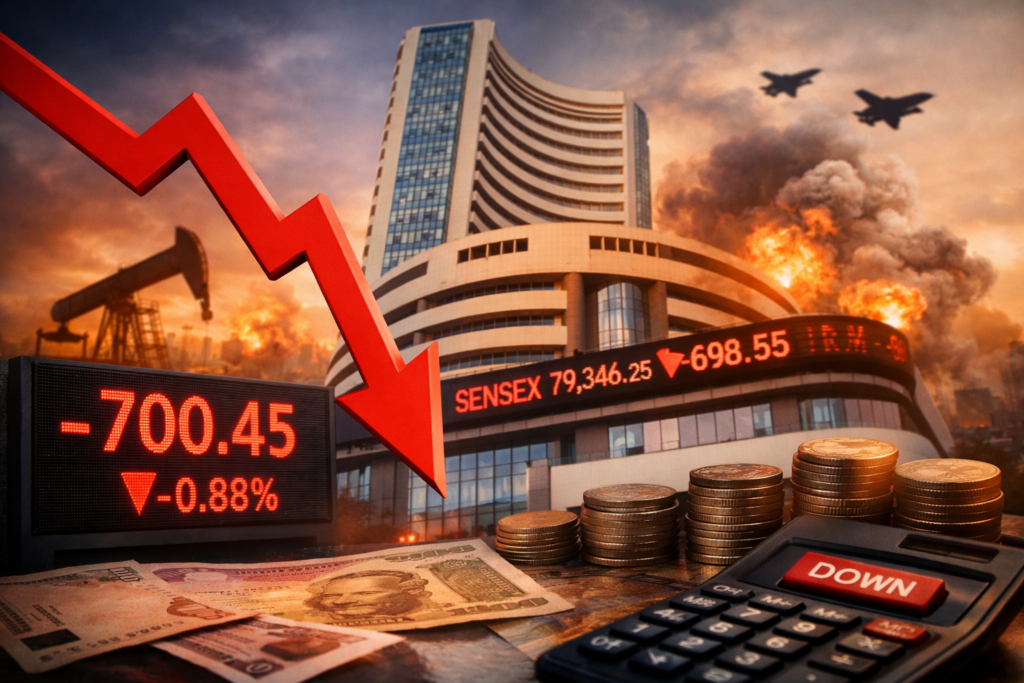
During intraday trading, the BSE Sensex plunged nearly 700 points, touching a low of 79,346. Meanwhile, the Nifty 50 declined by almost 200 points to around 24,575. The sudden fall erased nearly ₹1 lakh crore in investor wealth in just a single trading session as the total market capitalisation of BSE-listed companies dropped from about ₹453 lakh crore to ₹452 lakh crore.
Market analysts believe that the rally seen in the previous trading session was largely a short-covering bounce after recent losses rather than a strong trend reversal. As global uncertainties resurfaced, investors quickly moved to book profits, which triggered fresh selling pressure across sectors.
One of the major reasons behind the decline is the escalating conflict in the Middle East. The ongoing military action involving the United States, Israel, and Iran has entered its seventh day, raising concerns among global investors. Earlier reports suggested that Iran might be considering conditional negotiations with the United States, which had temporarily improved market sentiment. However, later media reports indicated that Tehran had not made any such proposal to Washington, increasing fears that the conflict could drag on longer than expected.
The uncertainty deepened further after reports that US President Donald Trump stated there is no fixed deadline for ending the conflict. Prolonged geopolitical tensions often make investors cautious and lead to volatility in financial markets worldwide.
Another key factor affecting the Indian market is the sharp movement in crude oil prices. The Middle East is a crucial hub for global oil supply, and any conflict in the region raises fears of supply disruptions. Rising crude oil prices are particularly concerning for India, which depends heavily on imports to meet its energy needs. Higher oil prices can push inflation higher, widen the current account deficit, and put pressure on the rupee. These macroeconomic concerns tend to weigh on equity markets.
Foreign Institutional Investors have also been pulling money out of Indian equities amid the uncertain global environment. Continuous selling by foreign investors reduces liquidity in the market and often leads to sharp declines in benchmark indices like the Sensex and Nifty. When global risks increase, international investors usually move their funds to safer assets such as US bonds or the dollar.
Also Read
 Jay Pawar Shares Video Allegedly Showing VSR Ventures Owner Rohit Singh Sleeping in Cockpit
Profit booking after the recent market recovery also contributed to Friday’s fall. After the indices gained more than one percent in the previous session, many traders preferred to lock in gains rather than hold positions amid rising global risks.
Despite the decline, market experts say that such corrections are not unusual during periods of geopolitical uncertainty. Investors are likely to remain cautious in the coming days as they closely monitor developments in the US-Iran conflict, crude oil price movements, and foreign investment flows.

If tensions escalate further or oil prices continue to rise, volatility in the Indian stock market may persist in the short term. However, analysts believe that the long-term outlook for the Indian economy remains stable, supported by domestic growth and strong corporate fundamentals.