
Social development refers to the improvement of the quality of life of individuals and communities by addressing issues such as poverty, education, health, inequality, and social justice. While governments formulate policies and schemes for development, their reach often remains limited due to administrative and resource constraints. In this space, Non-Governmental Organisations (NGOs) play a crucial role by working directly with people at the grassroots level. NGOs act as a bridge between the State and society, ensuring that welfare measures translate into real change on the ground.
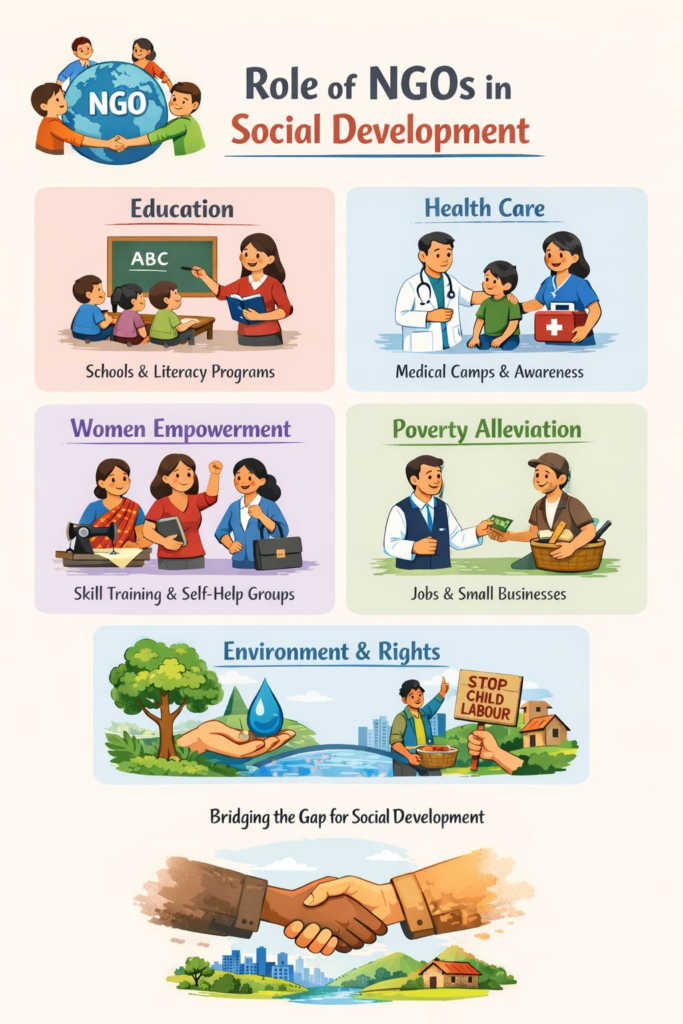
NGOs are voluntary, non-profit organisations that function independently of the government. Their strength lies in their flexibility, close community connection, and people-centric approach. Over the years, NGOs have emerged as powerful agents of social transformation in India and across the world.
One of the most significant contributions of NGOs is their grassroots engagement. Unlike large institutions, NGOs operate within communities and understand local needs, traditions, and challenges. For example, SEWA (Self Employed Women’s Association) has empowered millions of self-employed women by organising them into collectives, helping them access credit, skills, and social security. Such community-based approaches ensure participation, ownership, and sustainability of development initiatives.
NGOs also play a vital role in poverty alleviation and livelihood generation. Many organisations focus on skill development, vocational training, and income-generating activities to promote self-reliance. Pratham, known primarily for its work in education, also supports employability programmes for youth from economically weaker sections. Similarly, The Tata Trusts support livelihood projects in rural areas by promoting agriculture, handicrafts, and small enterprises, helping families achieve economic stability.
Education is another key area where NGOs have made a lasting impact. Millions of children remain outside the formal education system due to poverty, migration, or social barriers. NGOs such as Pratham Education Foundation work to improve basic literacy and numeracy among children through innovative learning methods. Akshaya Patra Foundation addresses a different but equally critical issue by providing mid-day meals to school children, improving nutrition while increasing school attendance and retention.
In the field of healthcare, NGOs often step in where public health infrastructure is inadequate. Organisations like Doctors Without Borders (Médecins Sans Frontières) and CARE India provide medical aid, maternal health services, and emergency healthcare in remote and disaster-affected areas. During the COVID-19 pandemic, numerous NGOs played a crucial role in distributing food, oxygen, medicines, and awareness material, demonstrating their importance during public health emergencies.
Women empowerment has been one of the most impactful areas of NGO intervention. NGOs actively work to promote gender equality, economic independence, and awareness of legal rights. Breakthrough focuses on preventing gender-based violence through education and advocacy, while Sakhi and similar organisations provide counselling, legal aid, and shelter to women facing domestic violence. By forming self-help groups and cooperatives, NGOs enable women to participate in decision-making and gain financial confidence.
Child welfare and youth development are also central to NGO activities. Organisations such as CRY (Child Rights and You) work to protect children from child labour, exploitation, and abuse, while ensuring access to education and healthcare. NGOs also conduct leadership programmes, sports initiatives, and career guidance workshops for youth, helping them become responsible and informed citizens.
Environmental protection has increasingly become a focus of NGO work, as environmental degradation directly affects social well-being. NGOs like Centre for Science and Environment (CSE) and WWF India promote environmental awareness, water conservation, sustainable development, and climate action. Community-based initiatives such as rainwater harvesting, afforestation, and waste management are often led by NGOs, creating long-term environmental benefits.
Beyond service delivery, NGOs play an important role in advocacy and policy reform. They highlight social issues, human rights violations, and gaps in existing laws through research, campaigns, and public engagement. For instance, NGOs working on disability rights and child protection have contributed significantly to shaping inclusive policies and legislation. By giving voice to marginalised communities, NGOs ensure that development remains inclusive and democratic.
NGOs also play a critical role in disaster relief and rehabilitation. During floods, earthquakes, cyclones, and other natural disasters, NGOs are often among the first responders, providing food, shelter, medical aid, and psychological support. Organisations such as Goonj are known for innovative relief models that combine dignity with disaster response by using material resources effectively.
Despite their contributions, NGOs face several challenges. Limited funding, regulatory hurdles, lack of skilled manpower, and accountability concerns often restrict their functioning. Dependence on donations and grants affects sustainability, while increased scrutiny requires NGOs to maintain high standards of transparency and governance.
For effective social development, collaboration between the government, NGOs, and the private sector is essential. NGOs must be supported through transparent funding mechanisms, capacity-building initiatives, and policy cooperation. At the same time, NGOs must uphold ethical standards, accountability, and professionalism to retain public trust.
In conclusion, NGOs play an indispensable role in social development by reaching communities that often remain beyond the effective reach of government machinery. Their grassroots presence, commitment to social justice, and innovative approaches make them powerful instruments of positive change. In a diverse country like India, sustainable and inclusive development is not possible without the active participation of NGOs. Strengthening their role is essential for building a more equitable, humane, and progressive society.
Name: Kiranjeet Kaur
Profession: Advocate
Contact No.: 7009197871