

New Delhi witnessed a stormy session in Parliament on Wednesday as Leader of Opposition Rahul Gandhi mounted a fierce attack on the government during the Union Budget 2026 debate. In a speech that quickly escalated into heated exchanges, Gandhi alleged that the India-US interim trade deal amounted to a “wholesale surrender” and even claimed that the government had “sold Bharat Mata.” His remarks triggered sharp objections from the Treasury benches and repeated interventions from the Chair.
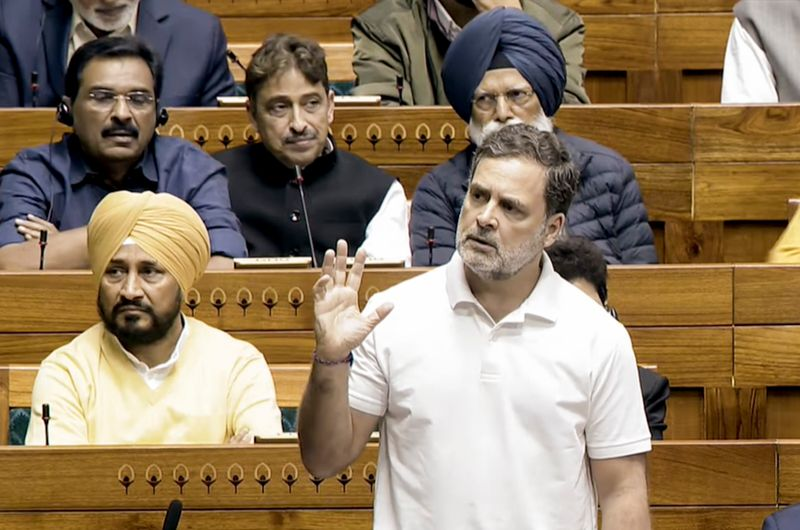
Framing his criticism against a rapidly changing global backdrop, Gandhi argued that the world is no longer dominated by a single superpower. He said the global order is shifting toward a multi-polar structure where China and Russia are challenging the United States. In such an environment, he warned, economic tools like energy supply and financial systems are being weaponised. According to him, India must tread carefully or risk compromising its strategic autonomy.
He placed artificial intelligence at the center of this global transformation. Gandhi cautioned that AI could disrupt India’s software industry and potentially replace large numbers of engineers. He emphasized that India’s real strength lies in the massive data generated by its 1.4 billion citizens. However, he argued that discussing AI without securing control over data and energy resources was meaningless. “It is like talking about a combustion engine without fuel,” he remarked, drawing attention from both sides of the House.
Turning directly to the India-US trade arrangement, Gandhi alleged that the agreement diluted India’s digital sovereignty. He claimed the deal removed the requirement for data localization, allowed free flow of Indian data to the United States, reduced digital taxes, and removed obligations related to source code disclosures. According to him, Indian data is a strategic national asset and should remain under domestic control. He insisted that India must negotiate with global powers as an equal and not allow itself to be treated on par with countries it considers strategically different.
The Congress leader also raised concerns over energy security, alleging that oil procurement decisions could now come under indirect American influence. He warned that non-compliance with certain expectations could expose India to punitive tariffs or trade pressure. On tariffs, he claimed that while American goods were entering India under favorable conditions, domestic industries were facing increasing burdens. Referring to a visit to a textile factory in Gurugram, he said business owners told him they were struggling due to tariff shifts and competitive disadvantages.
Agriculture featured prominently in his criticism. Gandhi argued that opening Indian markets to heavily mechanized American farm products could hurt local farmers growing maize, soybean, cotton, and other crops. He described the situation as unprecedented and suggested that no previous prime minister had taken such steps.
The most dramatic moment of his speech came when he declared that the government had “sold India” and “sold Bharat Mata.” Parliamentary Affairs Minister Kiren Rijiju immediately objected to the language used, calling it inappropriate. The Chair repeatedly asked Gandhi to avoid unverified allegations and to refrain from naming individuals without prior notice. BJP leaders, including Ravi Shankar Prasad, raised procedural concerns, demanding authentication of the charges being made on the floor of the House.
In a further escalation, Gandhi referred to the Epstein files, suggesting that certain Indian names appeared in material linked to investigations in the United States. He named Union Minister Hardeep Singh Puri and businessman Anil Ambani, alleging their names featured in documents with the US Department of Justice. The Speaker intervened firmly, directing that unverified claims would not be recorded in parliamentary proceedings. Gandhi maintained that he was prepared to authenticate his statements and insisted that evidence existed.
The government responded swiftly. Kiren Rijiju rejected the allegations outright, asserting that no one could sell the country and describing Prime Minister Narendra Modi as one of India’s strongest leaders. He accused the Opposition of making serious accusations without proof and said such remarks were irresponsible.
The debate underscored the sharp political divide over India’s economic and strategic direction. While the government maintains that the India-US trade deal strengthens India’s global standing and opens new economic opportunities, the Opposition argues that it risks compromising sovereignty in key areas such as digital governance, energy security, and agriculture.
As India navigates a complex global environment marked by geopolitical rivalry and technological disruption, the clash in Parliament reflects deeper questions about economic independence, strategic alignment, and the country’s long-term interests. The controversy surrounding the trade deal is unlikely to fade soon, and political tensions over the issue are expected to continue both inside and outside Parliament.