

Traffic on the Mumbai-Pune Expressway remained severely disrupted for over 24 hours after a gas tanker carrying highly flammable propylene overturned near the Adoshi tunnel in the Khandala Ghat section, leaving hundreds of vehicles stranded and causing widespread chaos on one of India’s busiest highways.
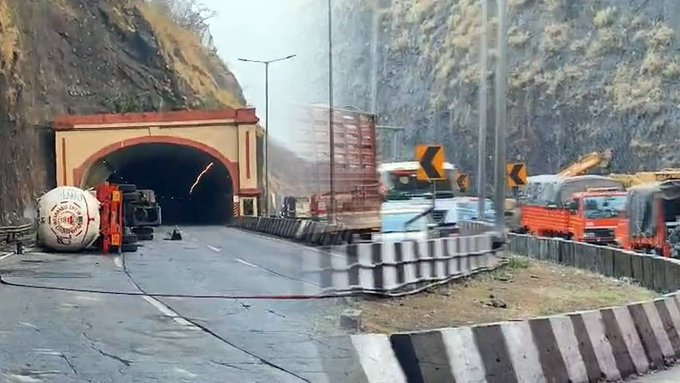
The accident occurred around 5 pm on Tuesday when the tanker reportedly lost control while descending a slope and overturned on the expressway in Raigad district. Soon after the incident, propylene gas was found leaking from the tanker, prompting authorities to immediately shut down traffic in the Mumbai-bound direction as a safety precaution.
By Wednesday evening, the situation had not fully normalised, with traffic congestion stretching for several kilometres on both carriageways. Vehicles remained stationary overnight near the accident site, forcing passengers, including women, children and senior citizens, to spend hours without access to food, drinking water or toilet facilities.
Emergency teams from the National Disaster Response Force, State Disaster Response Force and Bharat Petroleum Corporation Limited were rushed to the spot to manage the hazardous situation. Officials said another tanker was brought in to safely transfer the leaking gas, a process expected to take several hours due to the highly flammable nature of the substance.
The Pune-to-Mumbai lane of the expressway was completely closed, and vehicles were diverted to the old Mumbai-Pune Highway. To ease congestion, authorities allowed Mumbai-bound traffic to move through the Pune-bound lane in intervals of 15 to 20 minutes. However, the arrangement led to bottlenecks and slow-moving traffic in both directions.
The Maharashtra State Road Development Corporation said the Mumbai-bound carriageway was closed in the interest of commuter safety and confirmed that toll collection on the expressway had been suspended since early Wednesday. Highway traffic police urged motorists to avoid travelling on the expressway until normal traffic movement is restored.
The disruption had a major impact on public transport services. As many as 165 buses, including Shivneri and e-Shivneri services operated by the Maharashtra State Road Transport Corporation, were stranded at different locations. A total of 139 bus services were cancelled on Wednesday, including 73 e-Shivneri and 66 regular services, officials said.
MSRTC buses from multiple divisions such as Satara, Solapur, Pune, Sangli, Kolhapur, Palghar, Thane and Mumbai were affected by the traffic snarl. An MSRTC driver said his bus remained stuck just a few metres away from the accident site for nearly nine hours before finally reaching Navi Mumbai in the early hours of Wednesday.
Passengers and motorists took to social media to express their frustration, with several describing the expressway as a “parking lot.” Many complained of being stranded for hours without basic facilities, while others warned fellow commuters to avoid the route unless travel was unavoidable.
Officials said police diverted Mumbai-bound traffic onto the Pune-bound carriageway for a short stretch near the accident site, but continuous gas leakage prevented full restoration of traffic. Long queues and crawling movement were reported even for Pune-bound vehicles.
Authorities maintained that public safety remained the top priority and said traffic would be allowed only after the gas transfer operation was completed and the area was declared safe. Bus services are expected to resume in phases once traffic conditions improve.

The Mumbai-Pune Expressway, India’s first six-lane access-controlled concrete expressway spanning 94.5 kilometres, connects Mumbai, Navi Mumbai and Pune and handles thousands of vehicles daily. The prolonged disruption highlighted the vulnerability of the key transport corridor to hazardous material accidents.