

New Delhi: A sharp political exchange unfolded in the Lok Sabha on Wednesday as Union Finance Minister Nirmala Sitharaman delivered a strong rebuttal to Leader of Opposition Rahul Gandhi during the debate on the Union Budget. The House, already charged with tension, grew louder as Sitharaman countered Gandhi’s alleged remark that the “government sold India.”
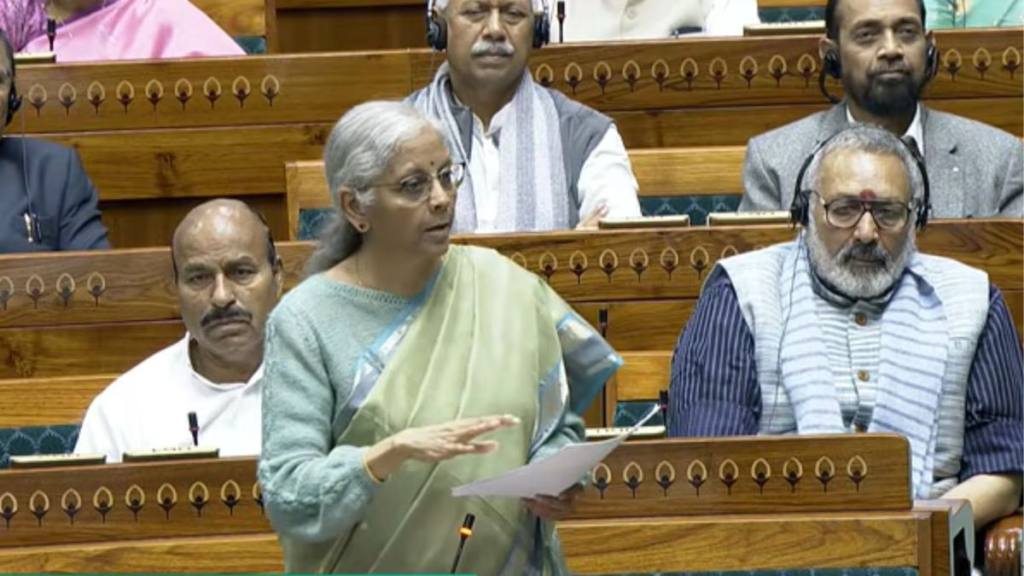
Responding firmly, the Finance Minister questioned the Congress party’s record and turned the criticism back on the opposition. She argued that it was the previous Congress-led government that had compromised national interests in crucial international negotiations.
Sitharaman specifically referred to the World Trade Organization’s Ministerial Conference held in Bali in December 2013. She claimed that the United Progressive Alliance government had accepted an interim “peace clause” on public stockholding of food grains instead of securing a permanent solution. According to her, this agreement could have restricted India’s ability to procure food grains from farmers at the Minimum Support Price (MSP) beyond January 2017 and might have affected subsidized food distribution to the poor.
“You sold out farmers in Bali,” Sitharaman said amid loud protests from opposition benches. She accused the Congress of trading the interests of farmers and vulnerable sections of society. Her remarks triggered sharp reactions from opposition MPs, but she continued to defend the government’s position.
The Finance Minister credited Prime Minister Narendra Modi with renegotiating terms after taking office in 2014. She stated that the Modi government secured safeguards that ensured uninterrupted MSP procurement and protected India’s public distribution system. She further emphasized that this framework later enabled the government to provide free food grains to nearly 80 crore beneficiaries during the Covid-19 pandemic, calling it proof of strong leadership and decisive action.
The debate then moved beyond trade policy as Sitharaman revisited the 2009 Sharm El Sheikh meeting between then Prime Minister Manmohan Singh and Pakistan’s leadership. She alleged that the Congress government had “hyphenated” India with Pakistan and delinked talks from the issue of terrorism, a decision she suggested weakened India’s diplomatic position.
“You are the ones who sold India, and you are lecturing us,” she said, directly addressing Rahul Gandhi. The remark intensified the already heated atmosphere in the House.
Although the session was meant to focus on the Union Budget, the exchange quickly evolved into a broader political confrontation over past decisions and governance records. Rahul Gandhi has consistently criticized the government’s economic policies, accusing it of undermining institutions and weakening public assets. The Treasury benches, however, defended their record and responded with references to Congress-era policies.
The clash once again highlighted the deep political divide between the ruling BJP and the Congress. As Parliament continues its Budget discussions, such exchanges are expected to shape the tone of debate both inside the House and in the wider political arena.
The Budget session may revolve around numbers and policies on paper, but Wednesday’s proceedings showed that history and political memory remain powerful tools in India’s parliamentary battles.