

The Middle East is facing a fresh wave of uncertainty after the United States ordered a powerful naval force to move closer to the region while Iran temporarily shut its airspace over Tehran. These developments highlight how quickly tensions are escalating between Washington and Tehran at a time when Iran is also dealing with intense domestic unrest.
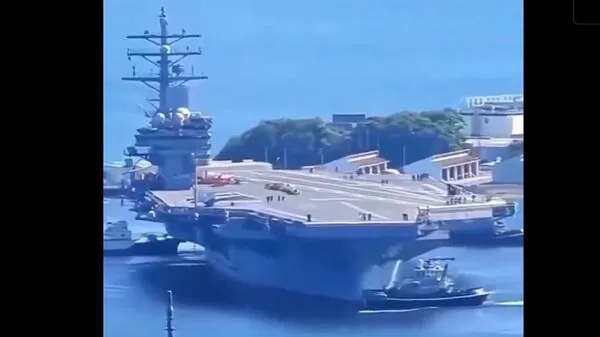
The Pentagon has redeployed a US carrier strike group from the South China Sea to the region covered by US Central Command, which includes the Middle East. The fleet is led by the aircraft carrier USS Abraham Lincoln and is supported by multiple warships, including at least one nuclear-powered attack submarine. Officials say the group is expected to reach the region within about a week.
Such a deployment is considered one of the strongest signals of American military readiness. Carrier strike groups are designed to project power, carry out air operations, and deter hostile actions. Their movement often reflects growing concerns about regional stability or the risk of conflict.
The decision comes as Washington closely watches the deepening crisis inside Iran. In recent weeks, large-scale protests have spread across several Iranian cities, driven by rising inflation, a collapsing currency, and growing public anger over governance. The unrest has reportedly left thousands dead, further increasing pressure on the Iranian leadership.
US President Donald Trump has been briefed on a range of options to deal with the situation. These reportedly include not only airstrikes but also cyber and psychological operations aimed at influencing Tehran and supporting protesters. While no official action has been announced, the military buildup suggests that the United States is preparing for multiple scenarios.
Meanwhile, Iran’s brief closure of its airspace over Tehran added another layer of tension. The shutdown lasted several hours and affected international flight routes that pass through Iranian skies. Only a limited number of flights with special clearance were allowed to operate during the restriction. Normal operations resumed later in the morning, but the move signaled heightened security concerns inside the country.
Airspace closures of this kind are unusual and often linked to fears of military or security threats. Coming at a time of growing friction with the United States, the decision raised concerns among airlines, governments, and investors across the region.
Security has also been tightened at key US facilities in the Middle East. At Al Udeid Air Base in Qatar, the largest US military base in the region, personnel were advised to leave the base as a precautionary step. The US Embassy in Saudi Arabia also instructed its staff to limit non-essential travel and remain alert. Officials said these measures were taken due to the overall security climate rather than a specific threat.
Across the Middle East, governments are increasingly worried about the consequences of any direct US-Iran confrontation. Several countries have reportedly warned Washington that military action against Iran could trigger wider instability, disrupt energy supplies, and damage already fragile economies.
With a US carrier strike group moving toward the region, Iranian airspace briefly shutting down, and protests continuing inside Iran, the situation remains highly volatile. Diplomacy is still in motion, but the military and political signals from both sides suggest that the coming days will be crucial in determining whether tensions ease or escalate further.