

The Uttar Pradesh government has ordered a departmental inquiry against Provincial Civil Services (PCS) officer Alankar Agnihotri after his resignation over the University Grants Commission’s newly introduced guidelines sparked a major administrative and political controversy. The officer, who was posted as City Magistrate in Bareilly, has also been suspended on charges of alleged indiscipline.
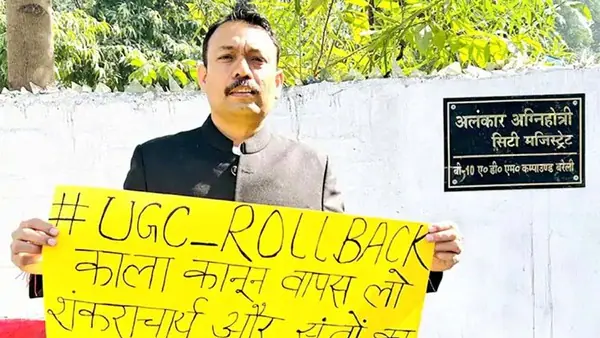
Late on Monday night, the state government issued a suspension order against Agnihotri, attaching him to the office of the District Magistrate, Shamli, pending investigation. The order stated that prima facie evidence pointed towards disciplinary misconduct, warranting immediate action under service rules.
The suspension order was issued by the Appointments Department-7 and signed by Special Secretary Annapurna Garg. It further mentioned that a formal departmental proceeding would be initiated, and Bareilly Divisional Commissioner B.S. Chaudhary has been appointed as the ex-officio inquiry officer to examine the allegations against the officer.
Earlier the same day, Agnihotri had sent his resignation via email to Uttar Pradesh Governor Anandiben Patel and Bareilly District Magistrate Avinash Singh. Along with his resignation, he released a public statement strongly criticising government policies, particularly the UGC’s new rules, which he described as a “black law.”
In his statement, the 2019-batch PCS officer expressed dissatisfaction with the direction of education reforms and also raised objections to the administrative handling of issues related to Shankaracharya Avimukteshwaranand. His remarks quickly gained traction on social media and triggered sharp reactions from political and bureaucratic circles.
The controversy comes amid the rollout of new UGC guidelines notified on January 13, 2026. These rules aim to curb alleged caste-based discrimination in higher educational institutions. Under the guidelines, universities are required to establish special grievance redressal committees, dedicated helplines, and monitoring mechanisms, particularly to address complaints from Scheduled Castes, Scheduled Tribes, and Other Backward Classes students.
While the central government has defended the guidelines as necessary reforms to ensure social justice and accountability, the rules have faced criticism from certain sections of society. Several public figures and commentators have questioned their implementation, calling for a review or withdrawal of the framework.
Agnihotri’s resignation and suspension have further intensified the debate. In his emotional appeal, he accused both the central and state governments of ignoring concerns of the general category and alleged disrespect towards the Brahmin community. He also urged elected representatives from the community to resign from their positions in protest.
The episode has reignited discussions on the boundaries of dissent within the civil services, the balance between personal conviction and official conduct, and the consequences of public criticism by serving officers. Administrative experts say the outcome of the inquiry could have long-term implications for service discipline and freedom of expression within the bureaucracy.
For now, Alankar Agnihotri remains under suspension as the departmental investigation proceeds. The case continues to draw national attention, placing the spotlight on governance, education reforms, and the evolving relationship between policy, politics, and administration.