

A routine visa interview at the US Embassy in New Delhi has unexpectedly turned into a viral flashpoint after Delhi-based entrepreneur Jasveer Singh publicly challenged the rejection of his visa application. What began as a standard administrative decision quickly escalated into a broader debate about transparency, fairness, and the impact of American immigration policies on Indian business leaders.
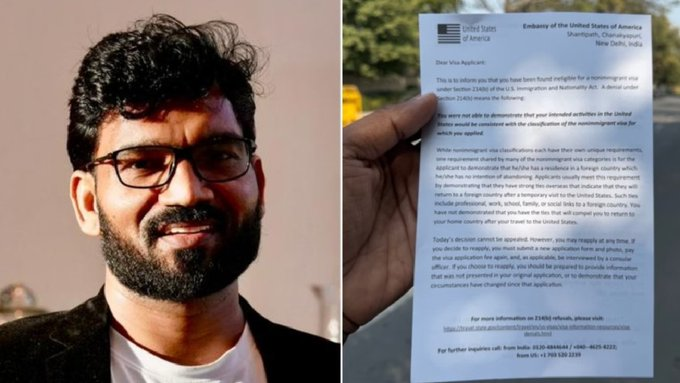
Jasveer Singh, co-founder and CEO of a matrimonial platform operating successfully in India for over 13 years, had applied for a US non-immigrant visa. His application was refused under Section 214(b) of the US Immigration and Nationality Act — a provision that presumes every applicant intends to immigrate permanently unless they can convincingly prove otherwise. To overcome this presumption, applicants must demonstrate strong ties to their home country, including stable employment, financial commitments, and family responsibilities.
According to Singh, he presented evidence of running a registered company in India, employing staff, paying taxes, and maintaining consistent business operations for more than a decade. Yet, the visa officer concluded that he had not sufficiently proven his intent to return to India after his visit.
Instead of quietly accepting the decision, Singh took to social media platform X and shared his frustration in a post that quickly gained traction. He questioned how 13 years of entrepreneurship, job creation, and tax compliance were not considered strong ties. Tagging US Ambassador Sergio Gor, he suggested that visa officers at the New Delhi consulate may need better training and greater sensitivity toward business applicants.
In one particularly striking remark, Singh hinted at the role of social media scrutiny in visa approvals. He wondered aloud whether deleting critical posts about US policies would increase an applicant’s chances of success. That line alone fueled intense online discussion, with many debating whether digital footprints are influencing decisions more than applicants realize.
US authorities have long acknowledged that social media profiles can be reviewed as part of the visa screening process. However, the extent to which such reviews impact final decisions remains unclear. The lack of detailed explanations for refusals under Section 214(b) often leaves applicants confused, adding to the perception of arbitrariness.
Singh’s experience is not isolated. In the aftermath of his post, other entrepreneurs began sharing similar stories. Among them was Bengaluru-based founder Dhananjay Yadav, who reportedly faced a comparable refusal under the same section. For India’s startup ecosystem, where international travel is often critical for investor meetings, conferences, and partnerships, such rejections create anxiety and uncertainty.
The timing of the controversy has drawn attention to broader immigration policies associated with former US President Donald Trump’s administration. Trump’s tenure was marked by a tougher stance on immigration, increased scrutiny of visa applicants, and a focus on preventing perceived immigration risks. While policies vary by visa type and administration, many applicants believe the overall approval climate has become more restrictive in recent years.
Business leaders argue that national security and immigration control are legitimate priorities for any country. However, they also stress that established entrepreneurs with documented track records should not be viewed with blanket suspicion. Legal experts point out that Section 214(b) decisions are discretionary and consular officers are not required to provide detailed reasoning, which can make the process feel opaque.
At its core, this episode reflects a larger tension between immigration enforcement and global business mobility. India and the United States share strong economic ties, and Indian entrepreneurs frequently travel to the US for trade events, collaborations, and funding opportunities. When high-profile refusals surface publicly, they resonate far beyond the individual case.
For now, US officials have not issued any public response to Singh’s viral remarks. But the conversation he ignited continues to circulate across professional networks and startup communities. His case has become a symbol of a broader concern: whether legitimate business credentials alone are enough to establish trust in today’s complex immigration landscape.
As debates over visa transparency and fairness intensify, one thing is clear — in a world where entrepreneurship depends on global connectivity, mobility has become more than a convenience. It is a necessity. And when that mobility is questioned, so too is the balance between security and opportunity.
Summary: Delhi-based entrepreneur Jasveer Singh’s US visa was rejected under Section 214(b), prompting him to publicly question the decision on X. He argued that running a company, employing people, and paying taxes in India for 13 years should demonstrate strong ties. His viral post sparked wider debate about social media screening, transparency in visa decisions, and the impact of stricter immigration policies. Similar experiences shared by other founders have added fuel to the discussion within India’s business community.