

The Supreme Court on Tuesday came down heavily on WhatsApp and its parent company Meta, raising serious concerns over user privacy, data collection, and the commercial use of personal information. The apex court observed that Meta appears to be driven primarily by profit, despite fully understanding that users across India have become deeply dependent on WhatsApp for daily communication.
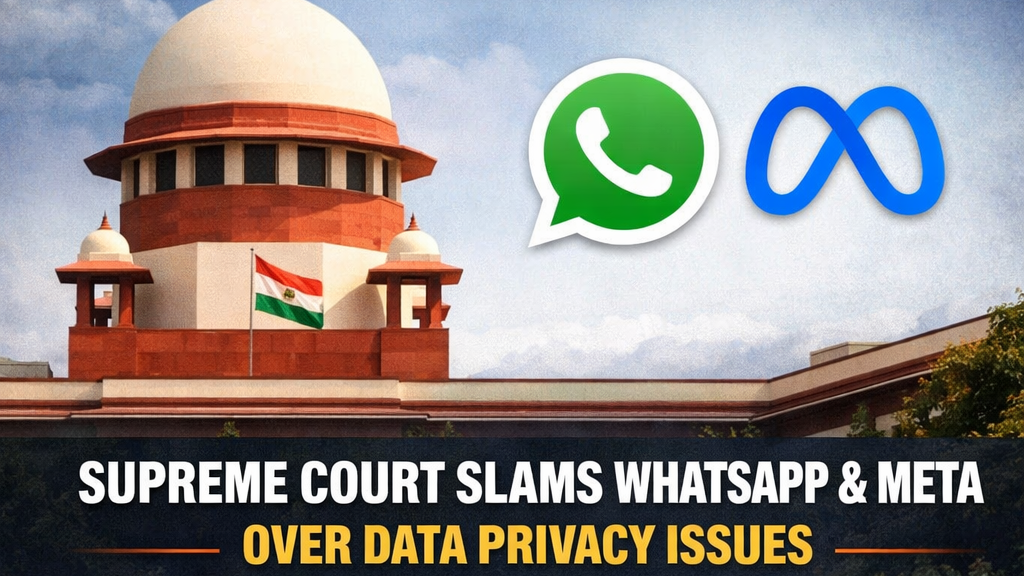
The strong remarks came during a hearing related to data protection and consent, where the court questioned whether ordinary users — especially those from rural and non-English-speaking backgrounds — can genuinely understand WhatsApp’s complex terms and conditions.
CJI Questions Informed Consent of Rural Users
Chief Justice of India (CJI) made sharp observations on the imbalance of power between global tech giants and everyday consumers. Referring to WhatsApp’s massive reach in India, the CJI pointed out that the platform is no longer optional for most citizens.
“You know your commercial interests very well, and you also know how you have made consumers addicted to your app,” the CJI told Meta.
The court highlighted a critical concern: how can a person sitting in a remote village in Tamil Nadu, who understands only their local language, be expected to fully comprehend detailed legal terms drafted in complex English?
The CJI asked Meta to provide a formal undertaking to the court, after which the matter would be examined on its legal merits.
‘WhatsApp Is for Communication, Not Data Trading’
The Supreme Court firmly stated that WhatsApp was created as a messaging and communication service, not as a platform to collect and monetise personal data.
“WhatsApp is not meant for collecting and selling data. You are here to provide messaging and communication services,” the CJI remarked.
The bench further noted that real-world examples clearly show how user data appears to be exploited. The court cited situations where a user shares a medical prescription with a doctor, and within minutes, receives advertisements related to medicines — raising serious red flags about data tracking and targeted advertising
Justice Bagchi Flags Misuse Beyond DPDP Act
Justice Bagchi added that the Digital Personal Data Protection (DPDP) Act is primarily focused on safeguarding privacy. However, he expressed concern that Meta may be using personal data for purposes that go beyond privacy protection.
“The DPDP Act talks about privacy, but you are using data for online advertising,” Justice Bagchi observed.
This remark underlined the court’s view that commercial exploitation of personal data — even if indirect — could violate the spirit of India’s data protection framework.
Broader Implications for Big Tech in India
The Supreme Court’s observations are being seen as a significant moment in India’s ongoing debate over digital privacy, consent, and Big Tech accountability. With millions of Indians relying on WhatsApp for personal, professional, and even medical communication, the case raises larger questions about transparency, informed consent, and ethical data use.
Legal experts believe the outcome of this case could set an important precedent for how global technology companies operate in India, particularly in relation to data sharing, advertising, and user rights.
What Happens Next?
The court has asked Meta to submit an undertaking, after which the case will be heard on its merits. The hearing is expected to closely examine whether WhatsApp’s data practices align with Indian law and constitutional privacy protections.