

India’s stock market witnessed a sharp correction on Wednesday as benchmark indices tumbled heavily, erasing massive investor wealth in just one trading session. The sell-off came after strong gains in the previous session, prompting investors to book profits amid growing global uncertainty and currency pressure.
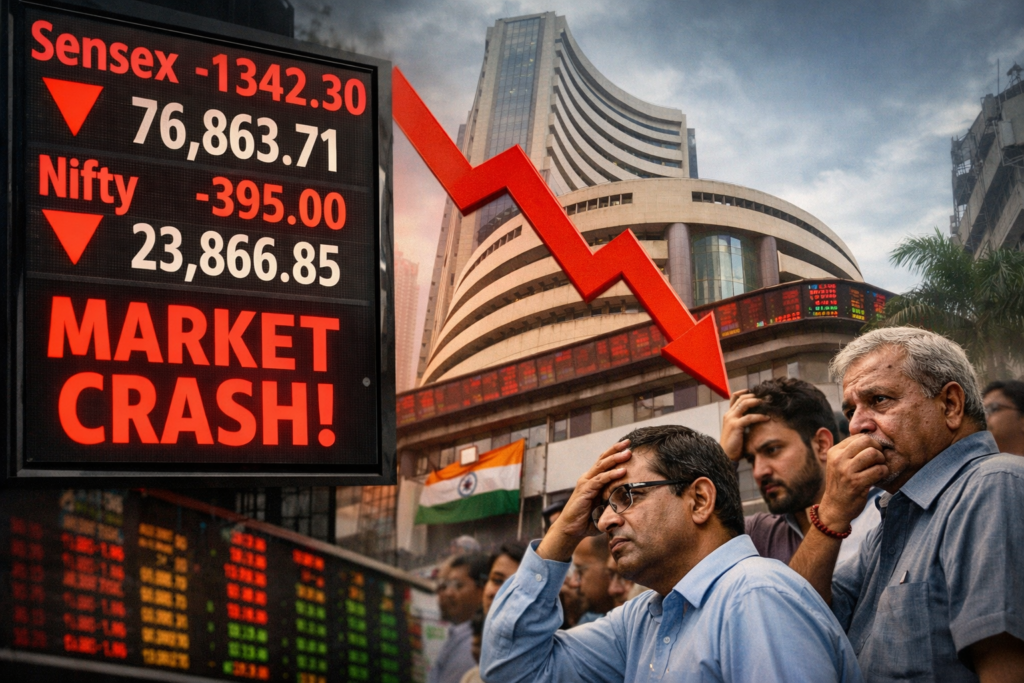
The BSE Sensex plunged 1,342 points, or 1.72 percent, to close at 76,863.71, while the NSE Nifty 50 dropped 395 points, or 1.63 percent, ending the day at 23,866.85. The decline was not limited to large-cap stocks. Broader markets also faced pressure, with the BSE MidCap index falling 1.13 percent and the SmallCap index slipping 0.32 percent.
The sharp fall wiped out nearly ₹5 lakh crore in investor wealth. The overall market capitalization of companies listed on the Bombay Stock Exchange dropped from around ₹447 lakh crore in the previous session to nearly ₹442 lakh crore by the end of the trading day.
One of the major reasons behind the decline was heavy profit booking in banking and financial stocks. Several market heavyweights saw strong selling pressure as investors locked in gains after recent rallies. Shares of major companies such as HDFC Bank, ICICI Bank, Axis Bank, Bajaj Finance, Bharti Airtel, Reliance Industries, and Mahindra & Mahindra contributed significantly to the fall in benchmark indices. The Nifty Bank index fell more than 2 percent, while the Financial Services index dropped around 2.3 percent. The auto sector also faced steep losses, with the Nifty Auto index falling over 3 percent.
Another factor that weighed on market sentiment was the weakness of the Indian rupee. The currency slipped below the 92 mark against the US dollar, closing at around 92.04. A weaker rupee often makes foreign investors cautious because it reduces their returns when investments are converted back into dollars. It also raises concerns about higher inflation, as a weak currency makes imports more expensive and may lead to higher interest rates.
Geopolitical tensions in the Middle East also added to the uncertainty in global markets. The ongoing conflict involving Iran and the combined forces of the United States and Israel has created fears of disruption in global oil supply. Reports indicate that the US military recently destroyed several Iranian boats near the Strait of Hormuz, a crucial global shipping route through which nearly one-fifth of the world’s oil supply passes. Any escalation in the conflict could lead to higher oil prices and increased economic uncertainty worldwide.
Foreign institutional investors have also been aggressively selling Indian equities in recent sessions. In the first few trading days of March alone, foreign investors reportedly sold stocks worth more than ₹32,800 crore in the cash segment. Rising crude oil prices, a strengthening US dollar, and the weakening rupee have all contributed to this outflow of foreign capital. Market experts also point out that some global investors have been cautious about Indian valuations and sectoral opportunities, which has further reduced foreign inflows.
Volatility in crude oil prices has become another key concern for the Indian economy and the stock market. Although oil prices have eased slightly from their recent highs, they remain unpredictable due to geopolitical tensions. For a country like India, which depends heavily on oil imports, a sustained rise in crude prices can widen the current account deficit, weaken the currency, and increase inflation. Higher energy costs can also affect corporate profitability and economic growth.
Despite the sharp fall, market analysts believe the correction reflects short-term caution rather than a fundamental weakness in India’s economy. Domestic institutional investors and mutual funds continue to provide support to the market through consistent investments. However, global developments, currency movements, and foreign investor activity are likely to influence market direction in the near term.

Investors are advised to remain calm during volatile phases and focus on long-term investment strategies rather than reacting to short-term market fluctuations.
Summary:
India’s stock market saw a sharp fall with the Sensex dropping 1,342 points and the Nifty falling 395 points, wiping out around ₹5 lakh crore in investor wealth. Profit booking in banking stocks, a weakening rupee, rising geopolitical tensions in the Middle East, heavy selling by foreign investors, and volatile crude oil prices were among the key reasons behind the decline. Market experts believe volatility may continue in the short term as global uncertainties remain high.