

India’s space agency, the Indian Space Research Organisation (ISRO), is investigating a technical irregularity that disrupted the PSLV-C62 mission shortly after its launch from the Satish Dhawan Space Centre in Sriharikota on Monday. The rocket was carrying the EOS-N1 Earth observation satellite, a key payload designed for strategic and commercial purposes. Although the liftoff and early stages of the flight proceeded normally, the mission encountered unexpected instability near the end of the third stage, causing the rocket to drift away from its intended trajectory.
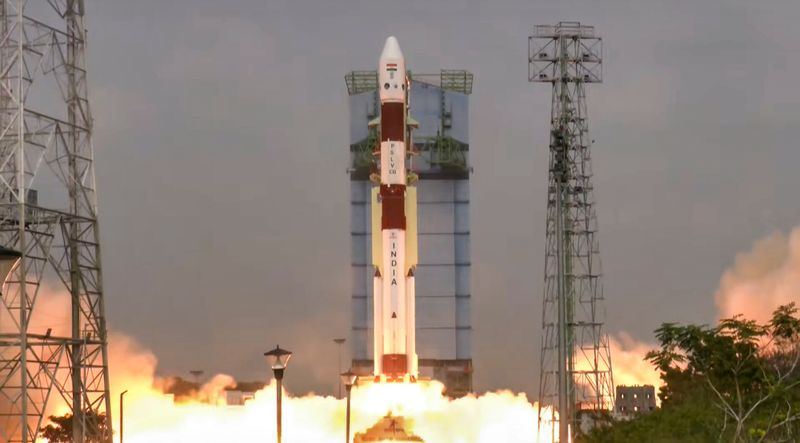
ISRO Chairman V. Narayanan confirmed that the launch vehicle performed as expected until the final moments of the third stage. However, abnormal roll behavior was detected, which led to a deviation in the flight path. Because of this disturbance, the mission could not achieve its planned orbital insertion. Engineers were able to receive full telemetry and flight data, which is now being carefully examined to understand the root cause of the failure.
The EOS-N1 satellite was built to provide high-resolution Earth observation data for national security, environmental monitoring, and strategic surveillance. The mission was also significant from a commercial standpoint, as it was undertaken by NewSpace India Limited (NSIL), marking its ninth dedicated customer mission. In addition to EOS-N1, the PSLV-C62 rocket was carrying 15 co-passenger satellites from Indian and international clients, along with a technology demonstrator from a Spanish startup designed to test atmospheric re-entry.
This incident has drawn attention because it is the second time in 2025 that ISRO has faced a third-stage anomaly in a PSLV mission. In May, the PSLV-C61 flight carrying the EOS-09 satellite also failed due to technical issues during the same stage of flight. The repeat occurrence has made the ongoing investigation even more important for ensuring the reliability of future launches.
The PSLV-C62 mission used the PSLV-DL variant, which is equipped with two solid strap-on motors to enhance lift capability. It was the 64th flight of the Polar Satellite Launch Vehicle, which has long been considered the workhorse of India’s space program. Over the years, PSLV has successfully launched landmark missions including Chandrayaan-1, the Mars Orbiter Mission, Aditya-L1, and the world-record mission that deployed 104 satellites in a single launch.
ISRO has now begun a detailed technical analysis involving propulsion systems, guidance mechanisms, and vehicle dynamics. Scientists and engineers are studying the data to identify exactly what caused the abnormal roll rates and trajectory deviation. Once the investigation is complete, ISRO is expected to release a comprehensive report and outline corrective measures to prevent similar issues in future missions.