

Mumbai turned into the centre of global diplomacy on February 17, 2026, as Narendra Modi and Emmanuel Macron held an important bilateral meeting at Lok Bhavan. The atmosphere was warm yet strategic, reflecting the depth of the India-France partnership that has steadily grown stronger over the past decade.
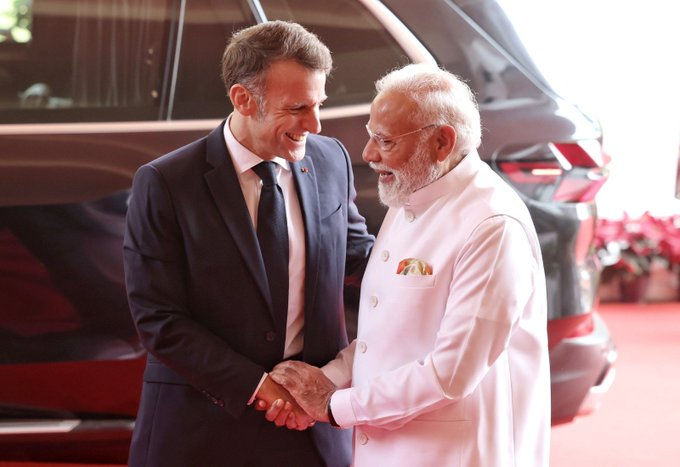
Prime Minister Modi welcomed President Macron with a hug, a moment that captured the personal rapport between the two leaders. Macron, who is on a three-day visit to India, arrived in Mumbai with First Lady Brigitte Macron and was received at the airport by Maharashtra Chief Minister Devendra Fadnavis and Governor Acharya Devvrat.
Earlier in the day, Macron was seen jogging along Marine Drive, a gesture that quickly drew attention on social media. Before the formal talks, he also interacted with well-known figures from Indian cinema, underlining the cultural dimension of the visit.
The meeting at Lok Bhavan focused on strengthening cooperation under the ambitious Horizon 2047 Roadmap. Both sides discussed expanding defence ties, accelerating collaboration in Artificial Intelligence, enhancing Indo-Pacific cooperation, and deepening partnerships in green energy, innovation, and education. Officials from the Ministry of External Affairs confirmed that digital technology and emerging innovation ecosystems were central to the dialogue.
One of the most significant developments ahead of the visit was India’s approval of additional Rafale fighter jets from France as part of a ₹3.6 trillion defence spending package. The move signals New Delhi’s continued strategic trust in Paris as a reliable defence partner. Defence cooperation remains one of the strongest pillars of bilateral ties.
Parallel to the leaders’ meeting, French Defence Minister Catherine Vautrin met Union Defence Minister Rajnath Singh in Karnataka. The two ministers co-chaired the 6th India–France Annual Defence Dialogue in Bengaluru. Discussions reportedly included extending defence cooperation for another decade and exploring joint manufacturing of advanced missile systems in India.
Artificial Intelligence emerged as a defining theme of Macron’s visit. After concluding engagements in Mumbai, he is scheduled to travel to New Delhi to attend the AI Impact Summit. India’s rapidly expanding digital ecosystem and France’s research strengths offer strong synergy in shaping global AI governance frameworks and responsible innovation standards.
Regional and global issues were also on the table. Both leaders exchanged views on Indo-Pacific stability, maritime security, and maintaining a rules-based international order. Their shared outlook on global challenges continues to drive strategic alignment between the two democracies.
The leaders also inaugurated the India-France Year of Innovation 2026, an initiative designed to connect startups, researchers, business leaders, and young innovators from both nations. The event highlighted the growing economic and technological depth of the partnership.
Security across South Mumbai was tightened during the high-level engagement, with traffic restrictions in place between 2 PM and 9 PM along key stretches near Regal Junction and surrounding roads.
This marks President Macron’s fourth visit to India and his first official engagement in Mumbai. Coming a year after Prime Minister Modi’s visit to France, the meeting reinforces sustained diplomatic momentum. Multiple MoUs are expected to be signed, followed by a joint press conference at Darbar Hall, Raj Bhawan.
The Mumbai meeting sends a clear message that India and France are entering a new phase of partnership — one built not only on defence strength but also on innovation, technology leadership, and shared strategic vision.