
Advocate Kiranjeet Kaur
Mobile: 7009197871
Justice is one of the most important pillars of any democratic country. In India, justice is not merely a legal concept—it is a solemn promise made by the Constitution to every citizen. The Preamble guarantees justice in social, economic, and political life. People approach courts with the belief that their grievances will be heard fairly and resolved honestly. However, when cases take years—sometimes decades—to conclude, this faith begins to fade. That is why the question “Is justice delayed still justice denied in India?” has become so relevant today.
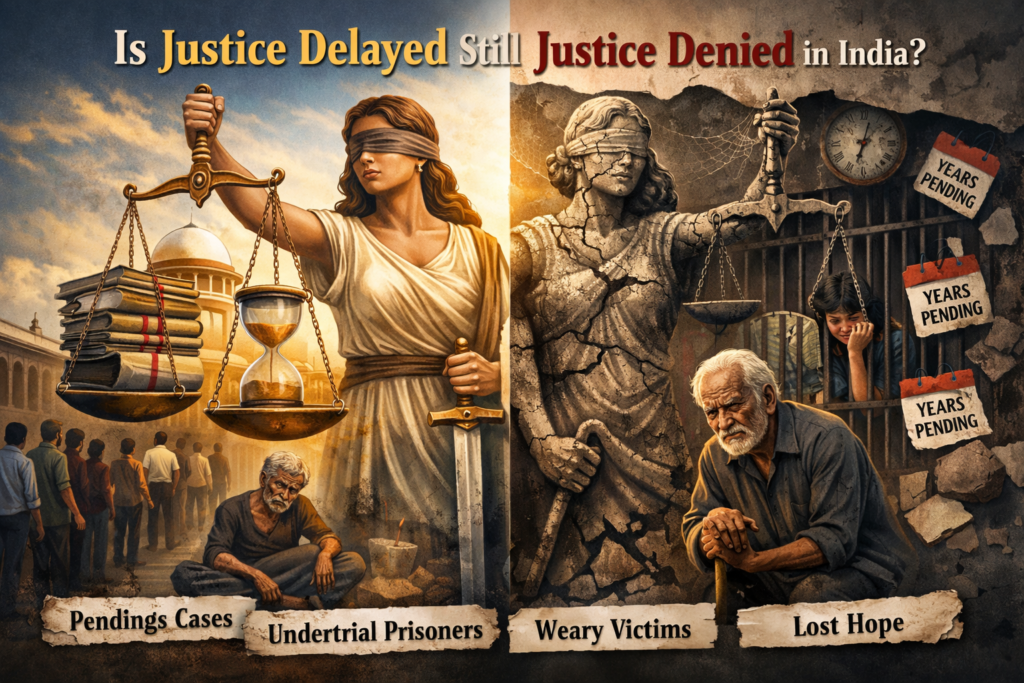
In simple terms, justice delayed means a person does not receive a court decision within a reasonable time, while justice denied means a person does not receive justice at all. When a judgment comes too late, it often loses its real value. A person may technically win a case, but the harm suffered may already be irreversible. For example, if a poor person fights for compensation for many years and finally wins when he is old, sick, or no longer alive, can that truly be called justice? In such situations, delay itself becomes a form of injustice.
India’s judicial system is respected worldwide for its independence and constitutional strength. Our courts have protected citizens’ rights in some of the most difficult times. Yet, the greatest weakness of this system is delay. Lakhs of cases are pending across lower courts, High Courts, and even the Supreme Court. Every pending file represents a human story—someone waiting, suffering, and hoping. Prolonged delays turn hope into frustration and faith into doubt.
One major cause of this crisis is the shortage of judges. India has a massive population, but the number of judges is extremely low in comparison. Many courts operate for years with vacant posts. Judges are burdened with hundreds of cases daily, making it nearly impossible to give each case the attention it deserves.
Another serious problem is the complex legal procedure. While laws and processes exist to ensure fairness, they often result in unnecessary delays. Lawyers frequently seek adjournments, and courts usually grant them. As a result, cases move slowly, sometimes without any real progress for years.
The impact of delayed justice is not equal for all. Poor and vulnerable people suffer the most. Wealthy individuals can afford long legal battles and expensive lawyers, but poor litigants struggle to bear court costs, travel expenses, and repeated hearings. Many abandon their cases halfway, not because they are wrong, but because they are exhausted and helpless.
The situation is even worse in criminal cases. A large number of people in Indian jails are undertrial prisoners. Some spend more years in jail waiting for trial than the maximum punishment for their alleged crime. When an innocent person loses years of life behind bars due to delay, no judgment can restore that lost time.
Victims also suffer deeply. Long trials reopen emotional wounds again and again. Over time, evidence weakens, witnesses forget or lose interest, and the chances of justice reduce. This discourages people from reporting crimes and weakens faith in the legal system.
Although the judiciary has introduced measures like fast-track courts, Lok Adalats, and digital hearings, these efforts are still not enough. Technology can assist the system, but without sufficient judges, infrastructure, and effective case management, delays will continue.
Conclusion
Justice delayed is, in most cases, justice denied in India. Justice must be delivered within a reasonable time for it to have real meaning. A society cannot call itself just when its people spend years—or even lifetimes—waiting for a court verdict. Speedy justice is not a luxury; it is a constitutional right.