

IndiGo Flight Chaos: India’s largest airline, IndiGo, plunged deeper into operational turmoil this week, cancelling more than 550 flights on Thursday—a new record for the 20-year-old carrier. The cascading disruptions, triggered by crew shortages and winter-related congestion, have left thousands of passengers stranded across the country.
IndiGo, which usually operates nearly 2,300 flights a day, has seen its on-time performance crash—slipping to 35 percent on Tuesday and hitting just 19.7 percent on Wednesday.
Sleepless Night for Chandigarh–Pune Passengers
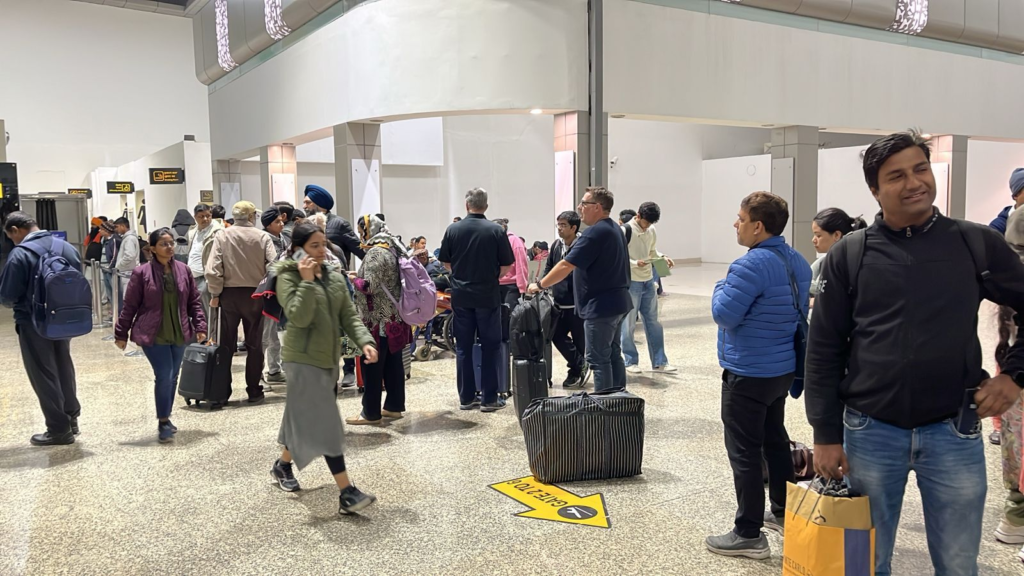
At Shaheed Bhagat Singh International Airport, frustrations peaked as the Chandigarh–Pune flight scheduled for 9:15 pm on Thursday finally departed at 7:50 am on Friday. Passengers—many of them elderly, students, and families—spent the entire night inside the terminal.
Throughout the night, passengers received multiple, conflicting updates:
- 9:15 pm → 11:45 pm
- 11:45 pm → 12:10 am
- 12:10 am → 1:10 am
- 1:10 am → Several more vague revisions
By 4 am, after a group of agitated passengers confronted IndiGo officials, the airline admitted that the inbound Pune–Chandigarh flight had only just begun boarding due to heavy congestion at Pune airport.
When boarding finally began around 7:15 am, yet another delay occurred after a passenger who had checked in luggage failed to board, forcing the crew to offload baggage. The flight eventually departed at 7:50 am.
“No Clear Answers All Night”
Passengers described a night of uncertainty and poor communication.
“Every update felt like a tactic to buy time. No one could give us a straight answer,”
said one passenger who had been waiting since evening.
Another traveller said the airline’s customer care numbers were “useless.”
“We kept calling, but no one picked up. It has been like this since last evening.”
Major Airports Hit Hard
IndiGo cancellations were widespread across major hubs, according to early estimates:
- Mumbai: 118 flights
- Bengaluru: 100
- Hyderabad: 75
- Kolkata: 35
- Chennai: 26
- Goa: 11
Several smaller airports also reported severe delays and cancellations.
Government Steps In
As disruptions intensified for a third consecutive day, senior officials from the Civil Aviation Ministry and the DGCA met IndiGo leadership on Thursday.
CEO Pieter Elbers acknowledged the severity of the crisis, warning employees that restoring punctuality would not be an “easy target.”
Root Cause: Miscalculation Under New Crew Duty-Time Rules
IndiGo has admitted that the chaos stems primarily from misjudging staffing needs under Phase 2 of the revised Flight Duty Time Limitations (FDTL) norms, which came into effect on November 1 following a court directive.
These rules—aimed at improving pilot fatigue management—significantly changed night-duty definitions and crew scheduling requirements.
However, IndiGo’s planning underestimated the extra manpower required for compliance. Combined with winter fog, runway congestion, and ongoing peak-season traffic, the airline’s scheduling system buckled.
Temporary Rollback to Ease Pressure
To stabilize operations, authorities have paused or rolled back two major provisions:
1. Night Duty Definition Restored
Shifted back from midnight–6 am to midnight–5 am
2. Cap on Two Night Landings Suspended
This gives airlines flexibility to deploy more pilots overnight.
These interim steps are expected to ease crew shortages and enable IndiGo to rebuild schedules over the coming days.
Looking Ahead
IndiGo has already announced planned cancellations for the next 2–3 days as it resets operations. While the airline is attempting to regain control, passengers are being urged to check flight status frequently and plan buffers for travel.
The situation remains fluid, but government oversight and temporary regulatory relaxations may help ease the worst of the disruption.