

The Indian rupee fell sharply on Wednesday, touching a historic low of 91.28 against the US dollar, as mounting global trade tensions and geopolitical uncertainty rattled emerging market currencies. The local unit opened weaker at 91.05 and extended losses through early trade, shedding 31 paise from its previous close.
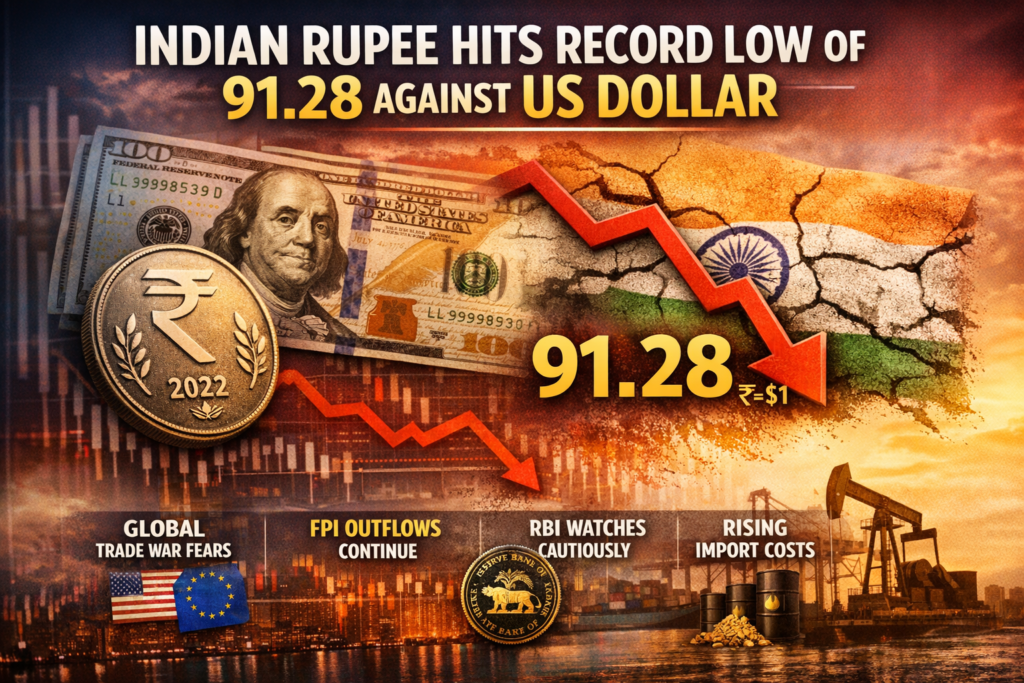
This marks the weakest level ever recorded for the rupee, surpassing its earlier intra-day low of 91.14 and closing low of 90.93 seen in mid-December 2025.
Global Trade Tensions Add Pressure
Renewed concerns over a possible global trade war weighed heavily on investor sentiment. Markets turned cautious after US President Donald Trump revived aggressive trade rhetoric, including fresh signals linked to Greenland, raising fears of a potential US–Europe trade dispute.
The uncertainty pushed investors towards safe-haven assets, intensifying pressure on emerging market currencies such as the Indian rupee.
Dollar Index Steady, But Risk-Off Mood Dominates
The dollar index, which tracks the greenback against a basket of six major currencies, edged 0.05% lower to 98.59. Despite the slight dip, the dollar remained firm overall, supported by elevated US Treasury yields, which touched four-month highs.
Market participants remain cautious as expectations grow that the US Federal Reserve may keep interest rates higher for longer, limiting appetite for riskier assets.
Equity Market Weakness and FPI Outflows Hurt Rupee
Domestic equities remained under pressure, further denting currency sentiment. The Sensex slipped 125.67 points to 82,054.80, while the Nifty 50 declined 45.80 points to 25,186.70.
Foreign Portfolio Investors (FPIs) continued to pare exposure to Indian equities, selling shares worth ₹2,938.33 crore on Tuesday alone. Persistent capital outflows have become a key factor behind the rupee’s sustained weakness.
Heavy Import Demand Adds to Dollar Buying
Forex traders pointed to strong dollar demand from importers, particularly in the energy and metals sectors. India’s heavy dependence on crude oil and industrial metal imports has increased dollar outflows, amplifying pressure on the local currency.
Meanwhile, Brent crude prices declined 1.14% to $64.18 per barrel, offering limited relief as currency sentiment remained driven by global uncertainty.
Expert View: What Lies Ahead for the Rupee
Amit Pabari, Managing Director at CR Forex Advisors, said uncertainty continues to dominate currency markets.
“A sustained break above the 91.07 level opens the door toward the 91.70–92.00 zone, unless the RBI steps in with active intervention. On the downside, the rupee may find initial support around 90.30–90.50,” he noted.
RBI’s Measured Strategy in Focus
Market participants believe the Reserve Bank of India is allowing a gradual depreciation rather than defending a specific level aggressively. The central bank is expected to intervene selectively to smooth volatility while conserving foreign exchange reserves.
Economic Impact of a Weaker Rupee
A depreciating rupee could make imports costlier and add to inflationary pressures, especially in fuel-sensitive sectors. However, exporters may benefit from improved realizations, providing some cushion to the broader economy.
Rupee Outlook: Key Factors to Watch
The rupee’s near-term direction will depend on several global and domestic triggers, including:
- US economic data and Fed policy signals
- Movement in crude oil prices
- Trends in FPI flows
- RBI’s stance on forex intervention
- Developments in global trade and geopolitics
For now, heightened risk aversion and global uncertainty continue to keep the Indian currency under sustained pressure.