

India has issued its first official response after US President Donald Trump expressed support for a powerful new sanctions bill that could impose massive 500% tariffs on countries buying Russian oil. The Ministry of External Affairs confirmed that New Delhi is fully aware of the proposal and is carefully monitoring the situation, as the potential economic consequences could be significant.
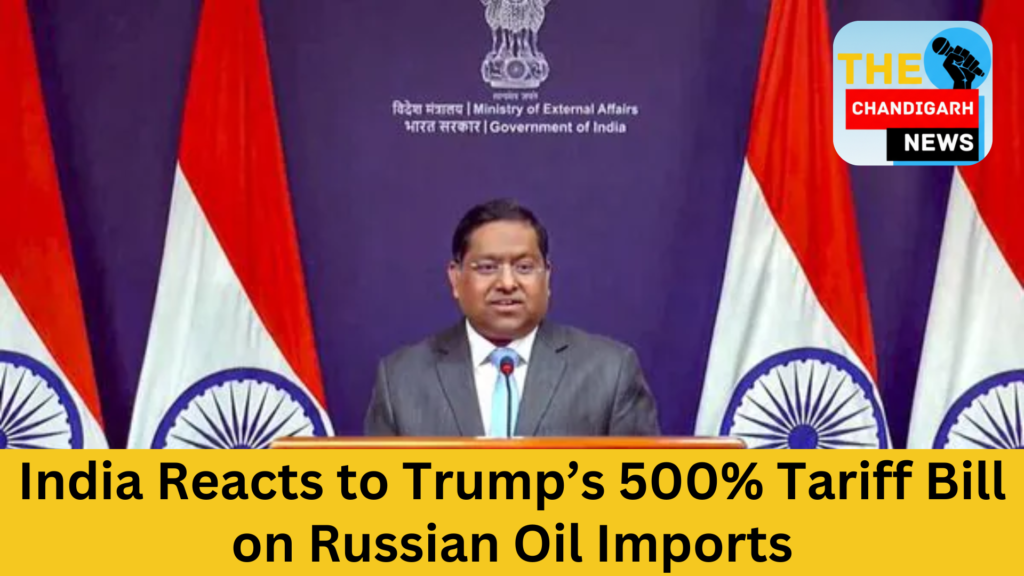
MEA spokesperson Randhir Jaiswal said India’s energy policy is guided by global market conditions and the need to ensure affordable fuel for its 1.4 billion citizens. He explained that India balances international developments with the responsibility of keeping energy accessible and reasonably priced for its people.
The proposed legislation, authored by Republican Senator Lindsey Graham and Democratic Senator Richard Blumenthal, would allow the United States to impose secondary sanctions and tariffs of up to 500% on countries that purchase Russian oil, natural gas, uranium, and other exports. The aim of the bill is to cut off a major source of revenue that Washington believes is helping finance Russia’s military operations in Ukraine.
A version of the bill introduced in April 2025 includes a provision that allows the US President to waive the 500% tariffs for up to 180 days if it is deemed to be in America’s national interest. This clause gives the White House flexibility in dealing with strategic partners.
Senator Graham recently confirmed that he met President Trump at the White House, where Trump expressed his support for the bill. A senior US official also confirmed that the proposal has the backing of the administration, making its chances of becoming law much stronger.
India has come under particular attention because it has significantly increased its imports of Russian crude since the Ukraine conflict began, taking advantage of discounted prices to stabilise domestic fuel costs. If the bill becomes law, US tariffs on Indian goods could rise from the current 50% to as high as 500%, which would severely impact Indian exports and trade relations with Washington.
Economic analysts warn that such steep tariffs could damage India’s export-driven sectors, reduce foreign investment, and slow overall growth. Even the existing 50% tariffs have already created pressure on Indian businesses, and a further jump would be extremely difficult to absorb.
Despite the growing pressure, India has continued to defend its energy strategy, arguing that it must prioritise affordability and security for its large population. Officials maintain that fuel sourcing decisions are based on market conditions rather than political alignment.
The issue has gained further importance as the US Supreme Court is set to deliver a key ruling on President Trump’s earlier tariffs on trade partners. Lower courts have already ruled that several of those tariffs exceeded presidential authority, and the upcoming verdict could influence how aggressively future sanctions are applied.
As the situation unfolds, India is entering a delicate phase of diplomacy, trying to balance its economic interests, energy needs, and strategic partnership with the United States. For now, the government says it is watching developments closely while preparing for all possible outcomes.