

Union Minister for Electronics and Information Technology Ashwini Vaishnaw has firmly rejected the International Monetary Fund’s (IMF) assessment that places India among “second-tier” artificial intelligence (AI) economies. Speaking at the World Economic Forum (WEF) Annual Meeting in Davos, Vaishnaw asserted that India clearly belongs to the first group of global AI leaders.
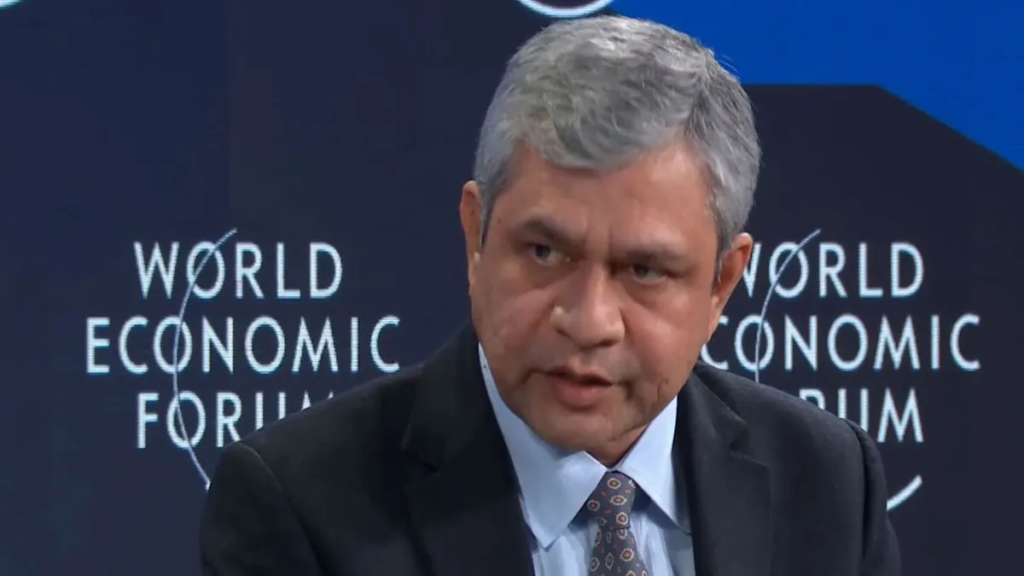
His remarks came in response to comments by IMF Managing Director Kristalina Georgieva, who had earlier categorized India outside the top tier of AI-driven economies. Addressing the panel directly, Vaishnaw questioned the basis of the IMF’s classification and presented global data to counter the claim.
“I don’t know what criteria the IMF has used, but Stanford places India third globally in AI penetration, AI preparedness, and AI talent,” Vaishnaw said.
Stanford Rankings Strengthen India’s AI Credentials
Citing Stanford University’s AI Index, the minister highlighted India’s strong global standing across key AI indicators. According to Vaishnaw, India’s performance in AI talent development and deployment reflects the country’s readiness to lead in the evolving technology landscape.
He categorically rejected the IMF’s categorization, stating:
“I don’t think your classification of India in the second group is right. India is actually in the first.”
Vaishnaw also underlined that India’s status as the fastest-growing major economy is closely tied to its expanding technology ecosystem and skilled workforce.
India’s End-to-End AI Strategy Across Five Layers
During the discussion, Vaishnaw outlined India’s comprehensive AI roadmap, spanning the entire technology stack. He explained that the government is focusing on all five critical layers of AI architecture:
1. Application Layer
India is expected to become the world’s largest supplier of AI-driven services, leveraging its enterprise expertise and deep understanding of business use cases.
2. Model Layer
The minister emphasized that AI success does not depend solely on building massive models.
“Nearly 95% of meaningful AI work can be done using models with 20 to 50 billion parameters,” he said.
3. Chip and Infrastructure Layers
India is steadily strengthening its semiconductor and digital infrastructure capabilities to reduce global dependence and ensure technological sovereignty.
4. Energy Layer
Recognizing AI’s energy-intensive nature, Vaishnaw said India is aligning AI growth with sustainable and scalable power solutions.
Focus on AI Diffusion, Not Just Innovation
Vaishnaw stressed that India’s priority is large-scale AI adoption, not limited innovation clusters. He revealed that India already has a “bouquet” of mid-sized AI models that are being deployed across sectors such as governance, manufacturing, services, and productivity enhancement.
“Our focus is to ensure AI diffusion happens in a very big way across the economy,” he said.
This approach, he argued, delivers real return on investment (ROI) by solving practical problems rather than chasing headline-grabbing model sizes.

India Choosing Its Own AI Path
Unlike other major economies, India is not blindly following the technology models of the United States or China. Vaishnaw made it clear that India is charting an independent course that aligns with its economic scale, talent base, and developmental needs.

The WEF panel also featured Saudi Arabia’s Investment Minister Khalid Al-Falih and Microsoft President Brad Smith, and focused on the intersection of AI and global economic growth.
India’s AI Future Looks Increasingly Central
With a strong talent pool, growing infrastructure, and policy-driven focus on adoption, India is positioning itself as a core player in the global AI transformation. Vaishnaw reiterated that international assessments must recognize India’s integrated and scalable approach to artificial intelligence.