

Canada has introduced a major shift in its immigration policy for 2026, bringing both opportunities and challenges for international students and temporary workers, especially those from India. The announcement, made on March 13 by Immigration, Refugees and Citizenship Canada (IRCC), signals a more controlled approach to migration while still keeping doors open for skilled talent.
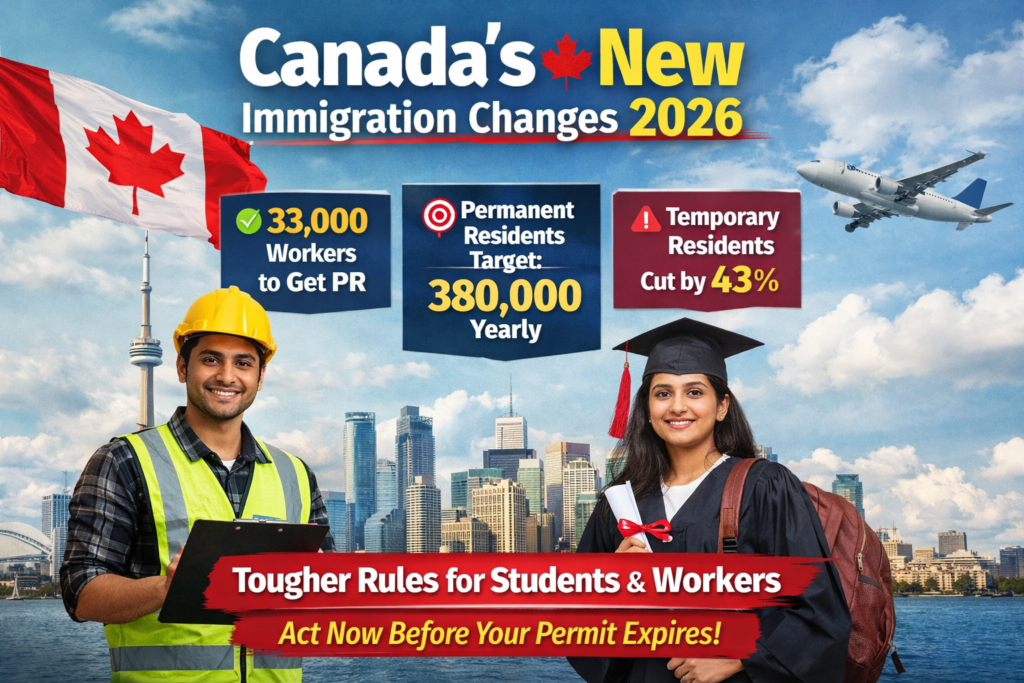
One of the biggest highlights is the soft launch of a new Temporary Resident to Permanent Resident (TR to PR) pathway. Under this program, around 33,000 temporary foreign workers will be granted permanent residency over 2026 and 2027. Importantly, these spots are additional and will not replace existing immigration programs such as Express Entry or Provincial Nominee Programs. The initiative is aimed at workers who are already contributing to Canada’s economy and have established roots in the country.
Although detailed eligibility criteria are yet to be fully released, early indications suggest that priority will be given to workers in sectors like healthcare, agriculture, hospitality, transportation, and caregiving services. Applicants are expected to hold valid work permits, demonstrate stable employment, and show strong community ties. Immigration experts are advising candidates to begin preparing documents such as employment records, tax filings, and proof of language proficiency.
At the same time, Canada has set its permanent residency target at 380,000 per year from 2026 to 2028. This marks a slight reduction from the 500,000 target in 2025, indicating a shift toward a more sustainable immigration model. A significant portion of these admissions will continue to focus on economic immigrants, reflecting the country’s need for skilled workers in key industries.
In a major policy shift, the government is also sharply reducing the number of temporary residents entering the country. New arrivals will drop from over 673,000 in 2025 to just 385,000 in 2026, a reduction of nearly 43 percent. This includes both international students and temporary workers. The move is intended to ease pressure on housing, healthcare, and public services, while ensuring better integration of newcomers.
For international students, the changes bring a mixed impact. While overall study permit numbers will be capped, there are benefits for higher education candidates. Master’s and doctoral students enrolling in public institutions will be exempt from certain documentation requirements, and doctoral applications will receive faster processing, with a target turnaround of just 14 days. At the same time, authorities will tighten checks on admission letters and institutional compliance to maintain quality standards.
Temporary residents whose permits are nearing expiry need to act carefully. They must either apply for an extension, switch to another visa category, apply for permanent residency through available pathways, or leave Canada before their status expires. Staying without valid status can result in serious consequences, including removal orders and future entry bans.
The immigration department is also working to improve processing times through digital upgrades and backlog reduction measures. Citizenship applications are expected to be processed within 12 months in most cases, and online citizenship tests have now become the standard for eligible applicants.
Overall, Canada’s new immigration framework reflects a clear shift from high-volume intake to a more targeted and strategic approach. The focus is now on attracting skilled workers who can fill critical gaps in sectors like healthcare, technology, and trades, while managing population growth more carefully.
Also Read
 Badshah Tateeree Song Row: Haryana Women’s Panel Orders Police Action After Rapper Skips Hearing
For Indians planning to study or work in Canada, the message is clear. Opportunities still exist, but competition is likely to increase, and early preparation will be key. Those already in Canada may benefit the most from the new pathway to permanent residency, while new applicants will need to navigate stricter entry limits and evolving requirements.