

The annual Basant Panchami puja was held on Friday at the historic Bhojshala complex in Madhya Pradesh’s Dhar district amid extensive security arrangements, as the Hindu festival coincided with Friday prayers of the Muslim community. Authorities remained on high alert throughout the day to ensure peace at the disputed site, which is revered by Hindus as a Saraswati temple and known among Muslims as the Kamal Maula Mosque.
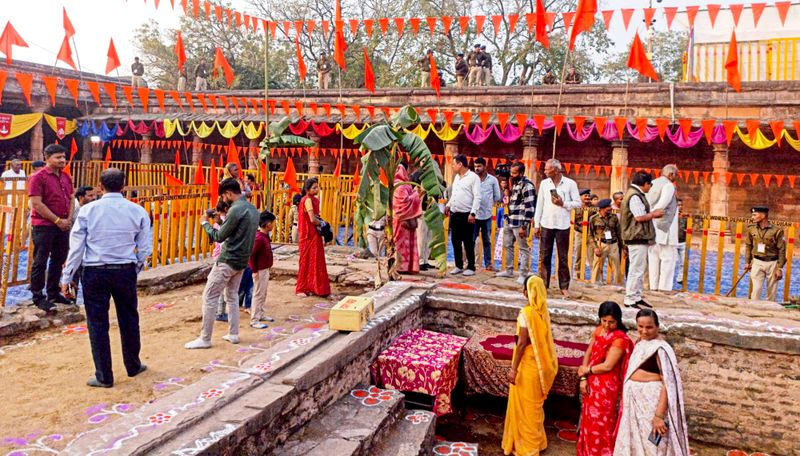
Nearly 8,000 police and paramilitary personnel were deployed across Dhar to prevent any untoward incident. Security forces maintained strict vigil at the Bhojshala premises and surrounding areas, while drones and CCTV cameras were used for continuous monitoring. Officials also kept a close watch on social media platforms to prevent the spread of misinformation or inflammatory content.
The heightened security followed a Supreme Court directive issued on Thursday, which laid down a clear time-sharing arrangement to avoid communal tension. As per the order, members of the Hindu community were allowed to perform prayers at the site from sunrise to sunset on Basant Panchami, while the Muslim community was permitted to offer namaz between 1 pm and 3 pm. The district administration implemented the order on the ground without deviation.
Devotees began gathering at the Bhojshala complex at sunrise, as the premises were decorated with saffron flags and flowers. Members of the Bhoj Utsav Samiti initiated the rituals by installing an idol of Goddess Saraswati, also known as Maa Vagdevi. The puja began with Vedic chants, followed by the commencement of the Akhand Puja, a continuous prayer ritual conducted from morning until evening. Offerings were made in the havan kund as devotees participated in the ceremony in large numbers.
District Magistrate Priyank Mishra said elaborate arrangements were made to ensure that religious practices of both communities could take place smoothly. He stated that coordination among administrative officials and security agencies helped maintain order throughout the day. While he did not disclose the number of people expected to gather for Friday prayers, he confirmed that alternative locations had been arranged for namaz.
Superintendent of Police Mayank Awasthi said the entire city had been mapped in advance and sensitive areas were identified. The disputed Bhojshala complex was divided into six security sectors, while the city was split into seven zones to ensure effective monitoring. He added that every street was under surveillance to prevent any disruption.
As the day progressed, the number of Hindu devotees at the complex steadily increased. Ashok Jain, a patron of the Bhoj Utsav Samiti, expressed satisfaction over the arrangements and thanked the Supreme Court for allowing the Akhand Puja at Bhojshala. He said that namaz was not being offered at the puja site, as the district administration had made separate arrangements.
Devotees also voiced hope for a lasting resolution to the long-standing dispute. Sarika Sharma, who attended the puja with her family, said she was happy to have the darshan of Goddess Saraswati on the auspicious occasion of Basant Panchami and wished for a permanent solution to the Bhojshala issue.
The Bhojshala complex, believed to date back to the 11th century, is a protected monument under the Archaeological Survey of India. In an order issued on April 7, 2003, the ASI allowed Hindus to worship at the site every Tuesday, while Muslims were permitted to offer prayers on Fridays. The arrangement has since governed religious practices at the monument, which continues to remain a sensitive and closely monitored location during major religious events.